
Working Mom Morning Routine: A Practical Guide for Indian Mothers
Anjali Sharma
Working Mom, Founder & Editor of The Balanced Working Mom
Practical, research-led guidance for Indian women navigating marriage, motherhood & work.

Table of Contents
At 6:45 AM on most weekdays, I am simultaneously packing a tiffin, answering a question about a missing library book, and mentally calculating whether last night’s sabzi can stretch into today’s paratha roll. My mother-in-law is already up and has chai on the stove. That is genuinely helpful. It also means the kitchen is occupied and the morning has witnesses.
If you are an Indian working mom — especially one managing a joint family household — your mornings are not just busy. They are layered. You are not only getting your child ready. You are navigating everyone else’s morning inside your own home, while also trying to leave in time for work.
This guide is for that version of mornings. Not the 4:30 AM yoga, journal for twenty minutes, make three chutneys version. The real one.
Why Indian Working Mom Mornings Are Uniquely Difficult
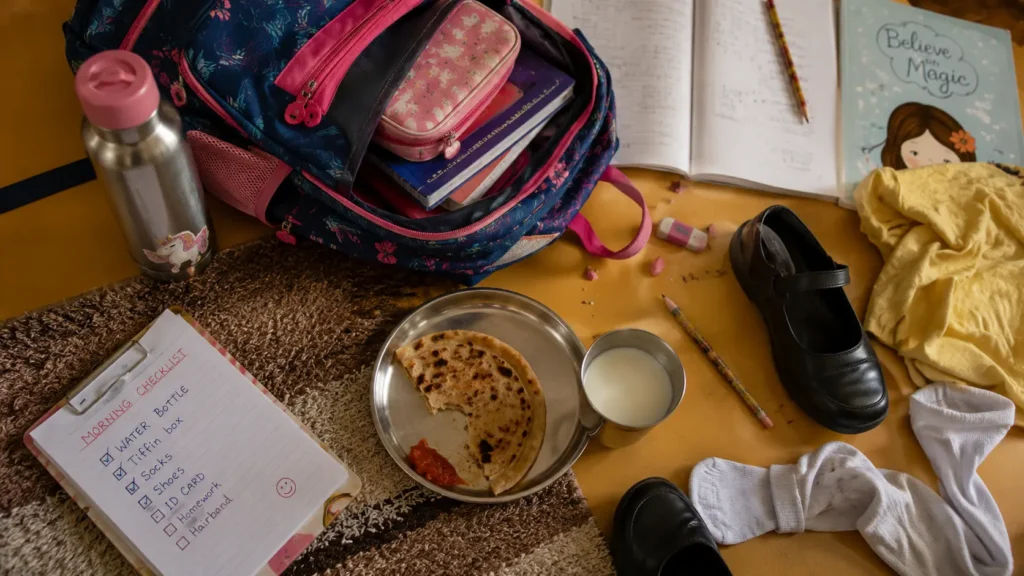
Most morning routine advice online is written for a certain kind of household — nuclear, two-income, with a fairly equal split of domestic labour. That is not most Indian homes, and it is definitely not most joint family homes.
Indian working moms are not just managing school runs and office deadlines. They are also managing:
- Breakfasts and tiffins for children who refuse half the things on the weekly plan
- Expectations around fresh cooking, even on rushed weekdays
- Coordinating with house help who may or may not show up on time
- The mental load of PTM dates, empty water bottles, signed permission slips, and whether there is enough curd in the fridge
- The unspoken bar that comes with being the bahu in a joint family — be efficient, be cheerful, make it look easy
That last one is worth naming clearly. In a joint family, you are not performing your morning routine in private. You are doing it with an audience, which adds pressure that no productivity blogger has ever written about.
That is exactly why a working mom morning routine matters. Not to do more, but to reduce the number of decisions and surprises that hit you before 9 AM.
What a Good Working Mom Morning Routine Actually Does for You
The goal is not perfection. The goal is smoother.
A well-built working mom morning routine should help you:
- Start the day with less shouting and less rushing
- Get children ready without a daily crisis
- Pack breakfast and tiffin without reinventing the menu every morning
- Reach work — or start your work-from-home day — feeling like you are ahead of the morning rather than behind it
- Keep at least 10 minutes that belong to you
Some mornings will still go sideways. The school bus will come early. Someone will spill milk on a freshly ironed uniform. Your period will arrive on a Monday. The maid will call in sick.
The routine is not there to prevent all of that. It is there to give you enough structure that even a difficult morning stays manageable.
Working Mom Morning Routine at a Glance
Every home is different, but this gives you a practical starting point. Adjust the timings based on your child’s school, your work hours, whether you commute or work from home, and how much help you have.
| Time | What to Do |
|---|---|
| 5:45 – 6:00 AM | Wake up before the children. Drink water, freshen up, take a few quiet minutes before the noise begins. |
| 6:00 – 6:30 AM | Start breakfast and tiffin prep. Keep it simple — this is not the time for ambition. |
| 6:30 – 7:00 AM | Wake the children. Give them a buffer. A rushed child almost always becomes a cranky child. |
| 7:00 – 7:30 AM | Breakfast, school readiness, packing, shoes, water bottles. |
| 7:30 – 8:00 AM | Get yourself ready. You also have to leave the house looking like a person. |
| 8:00 – 8:30 AM | Final checks, school drop, commute, or transition into work-from-home mode. |
Start the Night Before — This Is the Real Hack
The most effective part of any working mom morning routine happens the night before.
Waking up 15 minutes earlier does not help much if you are still hunting for the school ID card at 7:40 AM. The solution is not doing everything faster in the morning. It is doing fewer things in the morning.
Before sleeping, take 15 minutes to finish:
- Keep school uniforms, socks, shoes, and ID cards in one spot
- Pack school bags and check diaries for any notices
- Decide breakfast and tiffin for the next day — even a rough idea helps
- Chop vegetables or soak anything that needs time
- Keep your office bag, laptop, charger, and keys in one place
- Fill water bottles if your mornings are rushed
- Check the next day’s calendar for early meetings, school events, or deadlines
A useful rule: anything that causes panic in the morning needs a fixed home at night. School shoes do not belong under the sofa at 7:45 AM. The tiffin box should not be discovered unwashed inside the school bag.
Even if you manage this only four days out of five, the difference is noticeable.
5:45 AM: Wake Up Before the Rush
You do not need to wake up at 4:30 AM. Even 20 to 30 minutes before your children is enough to change the mood of your entire morning.
Use this time to wash your face, drink water, make tea, and think about the day ahead. Try not to open WhatsApp groups, Instagram, or office email in this window. The moment the phone takes over, the morning starts feeling noisy before anything has actually happened.
This is not a self-care ritual. It is a head start. The difference between waking up five minutes before everyone else versus half an hour before is enormous.
6:00 AM: Keep Breakfast and Tiffin Simple — Deliberately
For Indian working moms, the kitchen often decides the mood of the morning. And the kitchen pressure is real, especially in a joint family where a simple packaged cereal might raise eyebrows.
The answer is not to cook elaborate things faster. The answer is to have a simple, repeatable weekly plan that nobody can argue with because the food is genuinely good — just not Instagram-worthy.
Practical breakfast and tiffin ideas that actually work on busy mornings:
- Poha with peanuts and lemon
- Idli with coconut chutney or podi
- Paratha roll with leftover sabzi
- Besan chilla with curd
- Dosa with chutney (if the batter is ready the night before)
- Vegetable sandwich, toasted or plain
- Upma with vegetables
- Thepla with curd (theplas made in batch on Sunday last all week)
- Boiled eggs with toast
A sample weekly breakfast-tiffin plan:
| Day | Breakfast | Tiffin |
|---|---|---|
| Monday | Poha | Paratha roll |
| Tuesday | Idli | Fruit and sandwich |
| Wednesday | Dosa | Paneer roll |
| Thursday | Upma | Thepla and curd |
| Friday | Toast and eggs | Vegetable pulao |
Also keep emergency options that require zero effort: bread, eggs, bananas, roasted makhana, dry fruits, cheese slices, and ready dosa batter. On the days everything goes wrong, these are what get everyone out of the house fed.
6:30 AM: Wake the Children — Gently, With a Buffer

Children can make or break the morning. If you wake them at the last minute, they will make it.
Give them five extra minutes to adjust. Open the curtains, call them softly, let them sit up before they stand up. For younger children, a fixed wake-up phrase or song helps — something that signals “morning” without “hurry.”
For school-going children, a simple visible routine chart reduces how many times you have to say the same instruction. Something like:
- Brush teeth
- Use the washroom
- Wear uniform
- Comb hair
- Eat breakfast
- Put school bag near the door
Children do better when they know what comes next. And you will use fewer words before 7 AM.
7:00 AM: The Busiest Part — Breakfast and School Readiness
This half-hour is usually the most chaotic, so build in a little extra time. Some children eat slowly. Some suddenly remember that today is “bring something yellow from home” day. Some have opinions about their hair.
Keep breakfast realistic. Do not use this time for lectures about marks, incomplete homework, or messy handwriting. That conversation will go badly before 7:30 AM. Save it for after school.
A small “school exit station” near the door saves more time than anything else:
- School bag
- Water bottle
- Shoes
- ID card
- Raincoat or umbrella (seasonal)
- Any signed school notes
This one habit alone can prevent a lot of last-minute running around.
7:30 AM: Get Yourself Ready Too
Many moms get everyone else sorted and then sprint through their own routine. You end up starting your workday already tired and already slightly resentful, which is not a great foundation.
Keep your own getting-ready process simple and consistent. Choose your clothes the night before if you go to the office. Keep basic jewellery, your handbag, and footwear ready. Build a five-minute skincare routine for busy mornings rather than skipping it entirely.
For work-from-home moms, getting ready still matters. You do not need formal clothes, but changing out of nightwear sends a signal to your own brain that the day has started. A quick shower, comfortable clothes, and chai before opening the laptop makes a real difference to how the first hour of work feels.
8:00 AM: Final Check and Transition Into Work Mode
Once the children have left or settled, take five minutes before launching into your workday.
Quick check:
- Gas off?
- Tiffins packed?
- Laptop charged?
- Keys, phone, wallet, office ID?
- Anything urgent for school or work today?
Then pause for two minutes before the day fully begins. Not because you have time to spare, but because letting the morning rush bleed directly into work mode means you carry that rush with you for hours.
Mornings in a Joint Family: The Honest Guide

In a joint family, mornings look different. Help is available — sometimes a lot of it. But so are expectations.
The blessings are real. Someone may already be making chai or watching the baby. Your child has grandparents who will happily feed them a second breakfast. You are rarely doing this completely alone, and that matters.
The pressure is also real. The kitchen is shared, which means your cooking is visible. Packing Maggi in your child’s tiffin because you ran out of time feels different when your saas is standing three feet away. There are often unspoken standards about what a proper morning looks like — freshly made sabzi, hot breakfast, everything done before you leave.
A few things that help:
Fix a simple weekday menu and stick to it. When the plan is already decided, there is less room for commentary. “Mondays are poha days” is not a discussion. It is a system.
Divide tasks by person, not by availability. “Whoever is free does it” sounds flexible but usually means you end up doing everything. A clearer arrangement — even an informal one — reduces friction.
Set quiet boundaries around your departure time. You do not need a formal conversation. Simply communicating your timing consistently (“I need to leave by 8:15”) builds its own expectation over time.
Do not expect the joint family routine to be the same as a nuclear household routine. Things will take longer. More people are in the kitchen. Decisions get negotiated. That is the reality. Build a few extra minutes of buffer into your morning rather than fighting the pace.
The joint family morning is not worse than a nuclear family morning. It is different. The trick is to stop trying to follow routines designed for a different kind of home.
Morning Routine for Working Moms With Toddlers
Toddlers need flexibility above everything else. They may wake up happy one day and furious about their socks the next.
For this stage, prepare the night before as much as possible: clothes, diapers, bottles, snacks, daycare bags, two backup outfits. Do not leave anything dependent on morning decisions.
If your toddler resists eating early, pack a snack for later rather than turning breakfast into a battle every single day. A fruit pouch and some crackers in the daycare bag is a better outcome than forty minutes of crying and still no food eaten.
Toddlers also need connection before separation. Even five minutes of sitting together, cuddling, or talking quietly before daycare drop can make the goodbye easier for both of you.
At this stage, success is not a smooth morning. Success is everyone leaving the house with food, clothes, and fewer tears than yesterday.
Morning Routine for Working Moms With School-Going Kids
As children get older, they can slowly take over parts of their own morning routine. This is worth investing in, especially for working moms, because it directly reduces your daily load.
Even young school-going children can learn to:
- Keep shoes in one fixed place
- Put homework in the bag the night before
- Fill their water bottle
- Put the dirty tiffin box in the kitchen after school
- Choose between two outfit options you have already approved
This does not happen in a week. You will remind them many times. But the direction matters. “Mom does everything” should slowly become “Mom guides the routine.”
What to Do When the Morning Goes Wrong
Some mornings will just be bad. The child refuses breakfast. You wake up late. An 8 AM meeting appears in your calendar at 7:50. The maid does not show up. Someone spills milk on the school bag, the floor, and somehow also their own hair.
On those days: simplify everything.
Use the easiest breakfast. Tie the hair quickly. Pack the most basic tiffin. Leave the dishes. Let the house look imperfect. Order groceries later.
I have sent my son to school with just a banana and two biscuits on days when everything went wrong at once. He survived. So did I.
A difficult morning is not a reflection of how you are managing your life. It is just a difficult morning.
Small Habits That Actually Make a Difference in a Working Mom Morning Routine
These are not big changes. They are small things that compound over time.
Keep a weekly menu. Just 4–5 breakfast and tiffin options for the week. You do not need to follow it strictly — just having it reduces the daily “what do I make today” decision.
Create fixed homes for high-stress items. Keys, ID cards, school shoes, water bottles, and chargers should live in the same place every single day. The amount of time Indian households lose to “where is the thing” is staggering.
Use three alarms, not one. Your wake-up alarm, a child’s wake-up alarm, and a final leaving alarm. That last one is the one that actually saves mornings.
Keep emergency backup food always stocked. Bread, eggs, instant poha, bananas, roasted makhana, cheese slices. When the morning is impossible, these are what get everyone fed.
Teach children one task at a time. Not five new responsibilities in a week. One. “Your job is to put your shoes near the door every night.” That is it, for now.
Protect 10 minutes for yourself. Not for productivity. Not for checking email. Tea in silence, or sitting on the balcony, or doing the skincare routine without anyone asking you anything. This is not indulgent. It is what keeps you from starting every day already depleted.
A 30-Minute Working Mom Morning Routine for the Days When Everything Is Tight
For the mornings when the full routine is not possible:
- Wake up and freshen up quickly
- Start breakfast or reheat something prepped the night before
- Wake the children
- Lay out uniforms and pack bags
- Pack a simple tiffin — basic is fine
- Help kids eat and dress
- Get yourself ready, quickly but completely
- Final check and leave
On these days, do not aim for smooth. Aim for functional. Functional is enough.
FAQs About Working Mom Morning Routines
What is a good morning routine for a working mom?
A good working mom morning routine reduces last-minute stress by doing most of the heavy lifting the night before. It includes a simple weekly breakfast plan, fixed places for school and office essentials, and a predictable routine for children. For Indian working moms, it also means building in time for the realities of a joint family morning — shared kitchen, multiple schedules, and an audience for everything you do.
How can Indian working moms save time in the morning?
The biggest time-savers are night-before preparation and a fixed weekly breakfast menu. Keeping school uniforms, bags, shoes, and tiffin boxes ready the evening before removes the biggest sources of morning delay. Always having emergency food options — bread, eggs, bananas, ready batter — handles the days when the plan falls apart.
How can busy moms reduce morning stress?
Waking up 20–30 minutes before the children, dividing tasks clearly with a partner or family member, and creating a school exit station near the door all help. The bigger shift is mental: mornings get smoother when you stop trying to make them perfect and start optimising for “good enough and on time.”
What should working moms prepare the night before?
School uniforms, shoes, bags, tiffin boxes, breakfast ingredients, office clothes, laptop, charger, keys, and water bottles. Checking school diaries and your next day’s work calendar also prevents last-minute surprises. Even 15 minutes of this the night before makes a visible difference the next morning.
How can working moms manage mornings with toddlers?
Keep mornings flexible and prepare everything the night before — clothes, bottles, snacks, daycare bags, and a backup outfit. Accept that toddler mornings will not look neat and stop measuring them by the same bar as school-age mornings. Give your toddler a few minutes of connection before rushing into the goodbye. A calm separation is worth more than a perfectly packed bag.
How is the morning routine different in a joint family?
In a joint family, help is available but expectations are also higher. The kitchen is shared, routines are more visible, and there are more people to coordinate with. A simple weekly menu, clearly assigned tasks, and a consistently communicated departure time go a long way. Build a little extra buffer into joint family mornings rather than trying to operate at the same pace as a nuclear household.
Final Thoughts on the Working Mom Morning Routine
The best working mom morning routine is not the one that looks good in a reel. It is the one that works inside your actual home — with your children’s temperaments, your work timings, your commute, your joint family dynamics, and your own energy levels on any given day.
Some moms wake up at 5 AM and feel great about it. Some are up at night with a baby and need every extra minute of sleep they can get. Some have a partner who handles the school drop. Some are doing the whole morning alone while their husband leaves at 6 AM.
There is no single routine that works for everyone. What works is building a morning that gives you fewer last-minute decisions, fewer panicked searches, and — on most days — a few minutes that belong only to you.
You are not failing because mornings feel hard. You are carrying a lot. A routine is not there to make you do more. It is there to make the load feel a little lighter.

Hey there,
I’m Anjali, founder of The Balanced Working Mom.
I write for modern Indian women navigating marriage, career, motherhood, home, and the quiet identity shifts that happen in between.
Everything I share comes from real life — from managing work and family to learning, slowly, how not to lose yourself while building a beautiful life.