Rakhi After Marriage When One Festival Belongs to Two Families
Anjali Sharma
Working Mom, Founder & Editor of The Balanced Working Mom
Practical, research-led guidance for Indian women navigating marriage, motherhood & work.
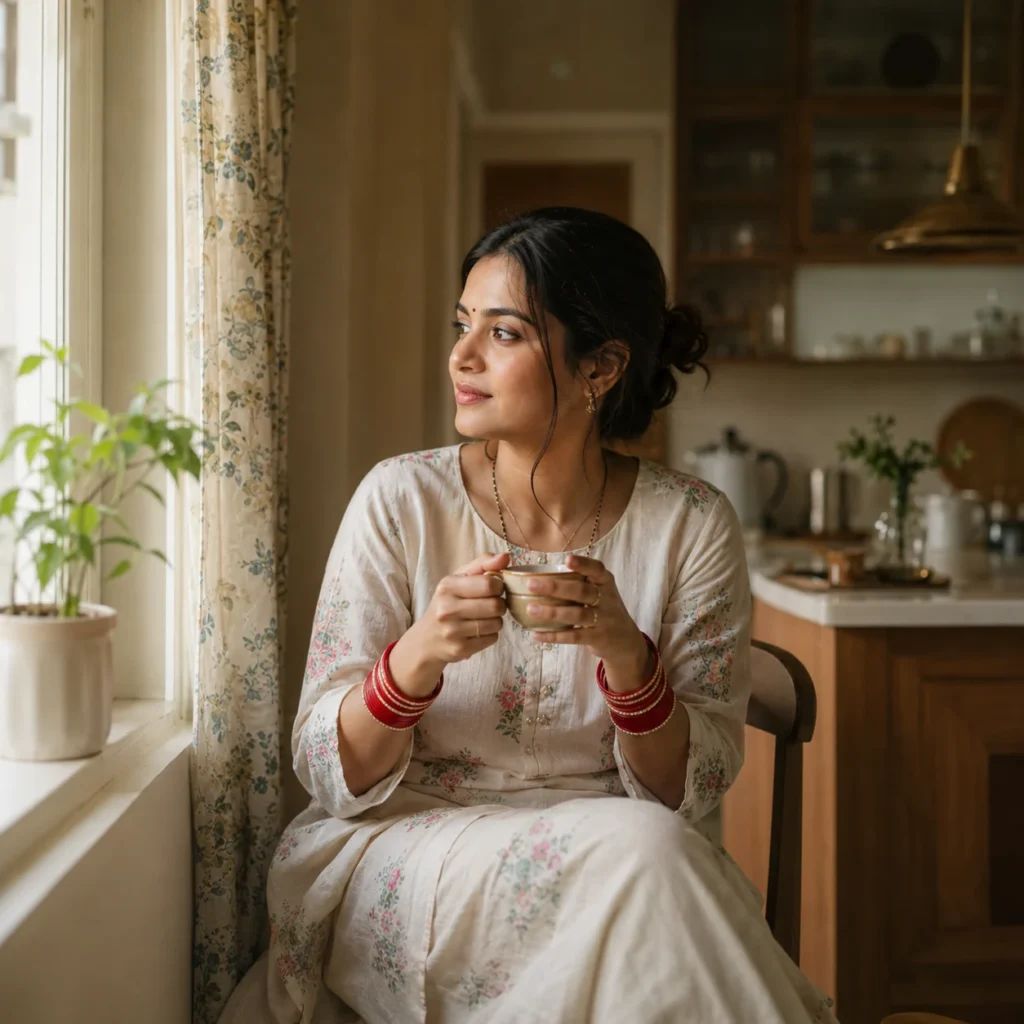
The thread stays the same size. It is everything standing around it that changes.
Table of Contents
Dear Indian woman,
My first Rakhi after marriage, I was in England, miles away from home and from my brothers.
Until then, Rakhi had always felt like one of those festivals you never really had to plan. My brothers were there. I was there. The thread, the mithai, the teasing, all of it belonged to the same house and the same morning.
Then I got married, moved away, and suddenly something that had always been automatic had a distance attached to it.
It has been almost nine years since my marriage. In all those years, I have been with my brothers for Rakhi only twice.
And somehow, life has only spread us out further.
Today, I am in Punjab. One of my brothers is in Dubai. The other is in Bangalore.
Three siblings. Three places. And every Rakhi, the same small thread trying to travel across all that distance.
I used to think this was simply what happened when people grew up. You get married. Jobs take people elsewhere. Families expand. Flights replace car rides. Festivals become something you coordinate over WhatsApp.
But Rakhi after marriage has made me understand something I did not notice when we all lived closer.
The thread did not become less important when we stopped being in the same room.
If anything, I finally understood what it was holding together.
The thread did not change. The room around it did
Here is what nobody warns you about your first Raksha Bandhan after marriage.
The ritual itself may barely change.
There is still the rakhi. The mithai. The jokes you have heard for years. Your brother behaving as though allowing you to tie a thread around his wrist is some enormous personal sacrifice.
What changes is everything around it.
Before marriage, Rakhi was not necessarily an event you organised. It was simply a morning that happened in a family you were already physically part of every day.
After marriage, there can be another home, another family calendar, work, travel, children, flights and hundreds or thousands of kilometres between the people who once only had to walk into the next room.
For some women, Rakhi after marriage means deciding whether to spend the day at their parents’ home or with their marital family.
For others, like me, there is no house to choose because the siblings themselves are no longer in the same city or even the same country.
Marriage does not change who you tie the thread to. It changes everything standing around that moment.
That is what makes Raksha Bandhan after marriage feel different.
Not because you love your brother more.
Not because you love him less.
Because something that used to happen automatically now has to happen intentionally.
Rakhi has long connected married sisters with home
There is something about the history of Raksha Bandhan that made me look at this differently.
In parts of northern India where women traditionally married outside their natal village, Rakhi became closely associated with the continuing relationship between a married sister and the family she had left behind.
Researchers studying North Indian traditions have described married women returning to their natal homes for Raksha Bandhan, with brothers sometimes travelling to bring their sisters back for the occasion. The ritual helped reaffirm that marriage had changed where a woman lived, but not her place within the family she came from.
I find that much more moving than any story about the perfect Rakhi gift.
For generations, Rakhi has carried a special meaning for the sister who left home after marriage.
The circumstances have changed.
Maybe you did not marry into the next village. Maybe you moved to London. Dubai. Bangalore. Toronto. Gurgaon.
Maybe nobody needs to come and physically escort you home anymore.
But the question underneath it is surprisingly similar.
When life takes a daughter somewhere else, how does she continue to belong to the family she came from?
Rakhi offers one small answer.
The address can change.
The relationship does not have to.
When one festival belongs to two families
Marriage also means Rakhi is no longer happening around only one family.
Your mother may have a picture in her mind of the day.
Your husband’s family may have their own Raksha Bandhan traditions.
Your brother may now have a wife and children. You may have children of your own. There are more calendars, more relationships and more people around a festival that once seemed incredibly simple.
And nobody has to be doing anything wrong for it to feel complicated.
That matters.
Because we have a habit of turning family logistics into tests of love.
If she comes to her maayka, does that mean she is prioritising her parents?
If she stays with her husband’s family, has she forgotten her own?
If she cannot travel at all, did Rakhi somehow matter less this year?
No.
Sometimes a flight is simply a flight.
A work deadline is a work deadline.
A child getting sick is a child getting sick.
And living in three different cities is geography, not a statement about who matters more.
You can name the difficulty without turning either family into the villain. You do not have to prove you are the perfect bahu by making every family plan work for everyone.
You did not stop being a daughter
This is the part I most want you to keep. There is a way we sometimes talk about marriage where a woman goes somewhere.
Ab woh apne ghar chali gayi. Now she has gone to her home.
It can be said with enormous love. It can be said by parents crying at a wedding. But hidden inside the sentence is a strange piece of arithmetic.
One family gained you.
So perhaps the other one lost you.
I don’t believe that arithmetic works.
And Rakhi gives us one of the clearest reminders of why.
You did not stop being a daughter because somebody started calling you a wife.
You did not stop being a sister because your address changed.
You did not transfer.
You expanded.
You are still the daughter who knows which kitchen drawer never opens properly.
You are still the sister who remembers exactly which childhood story will embarrass your brother in front of his wife.
You still have relationships that existed before your marriage and deserve to exist after it.
You can love your new family and still miss your old life. Both things can be true.
A daughter who married did not leave a family. She joined a second one.
Being part of your husband’s family does not require becoming smaller in your own.
That is not divided loyalty.
It is simply a bigger life.
The circle is allowed to get bigger
And this is the more hopeful part of Raksha Bandhan after marriage.
Marriage does not only create distance or complicated calendars.
It can add people to the celebration too.
Your husband can become someone who understands why that video call with your brother cannot be postponed until tomorrow.
He can learn your family’s jokes instead of sitting politely outside them.
Your brother’s wife can become part of your life rather than someone standing beside your sibling relationship.
Some Rajasthani and Marwari families have traditionally reflected this through the Lumba Rakhi, which is tied to a brother’s wife’s bangle. It extends the celebration beyond the brother alone and acknowledges the household around him. Raksha Bandhan traditions vary considerably by region, so this is not a universal custom.
You do not need to adopt someone else’s ritual.
I simply like what the tradition admits.
Families change.
And festivals are allowed to change with them.
Some homes will have a huge Rakhi lunch.
Some will tie the thread at seven in the morning before work.
Some siblings will sit beside each other.
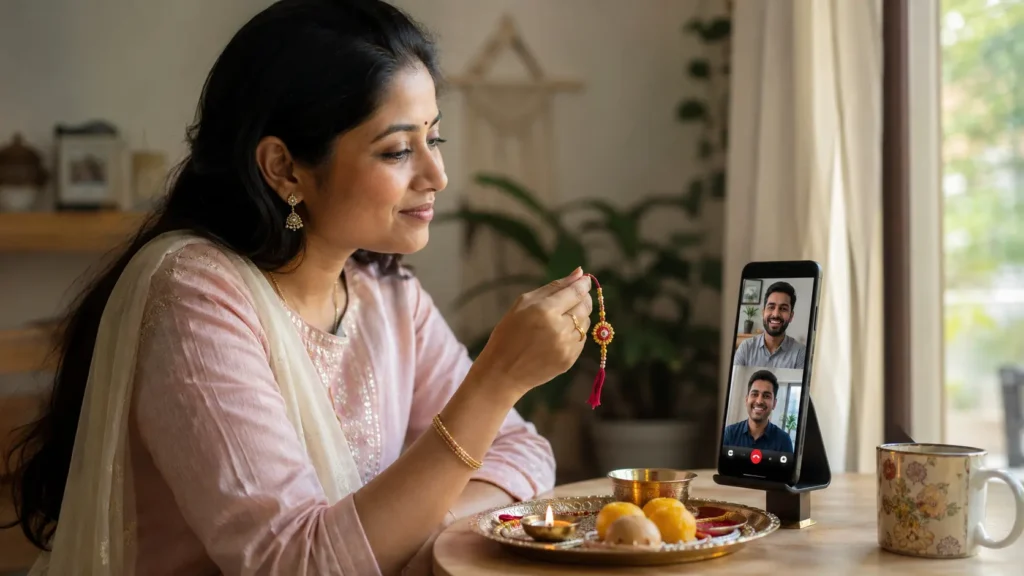
Some will be looking at each other through a phone screen from different time zones.
None of those versions automatically means more love than another.
Distance changes Rakhi but not the relationship
For me, this has become one of the biggest lessons of Rakhi after marriage.
Almost nine years.
Only two Rakhis together.
Those numbers sound sad when I write them like that.
But they are not the whole relationship.
Today I am in Punjab. One brother is in Dubai. The other is in Bangalore.
I cannot make those three places collapse into one living room simply because the calendar says Raksha Bandhan.
What I can do is refuse to let distance make the relationship casual.
That may mean sending the rakhi early.
It may mean fixing a time for a video call instead of saying, “We’ll call sometime.”
It may mean continuing some ridiculous childhood tradition that nobody outside your family would understand.
Sometimes the smaller and more specific the ritual, the better it survives.
And this is hardly a new problem. Even mid-20th-century accounts of Raksha Bandhan recorded sisters mailing rakhis to brothers who had moved to distant cities when they could not visit them in person.
The technology changes.
Apparently siblings refusing to live conveniently near each other does not.
Send this part to your brother
I am going to break form here because he needs this part too, and there is very little chance your brother is voluntarily Googling “Rakhi after marriage.”
To the brother reading this because your sister sent it to you:
If she cannot come home for Rakhi, do not confuse logistics with distance in the other sense.
Marriage, work and life may have changed how easily she can turn up at the door. They did not quietly cancel her membership in the family.
Keep inviting her.
Even in the years when both of you know she cannot come.
Being invited and being unable to be there feels very different from slowly no longer being expected.
Keep one stupid sibling tradition alive. The sweet. The joke. The nickname she hates. Whatever belongs specifically to the two of you.
And get to know the family she has built too.
Her being married does not make you a guest star in her life.
It only means both of you have to become more deliberate about a relationship that used to be automatic.
Right.
Back to you.
What to do when you cannot be together for Rakhi
I love emotional writing, but at some point somebody still needs to book the courier.
So here are five things that have become more useful to me than trying to recreate the perfect childhood Rakhi every year.
1. Protect one thing that belongs to the two of you
You do not need to reproduce the entire day.
Keep one detail.
The same mithai. The same teasing phone call. Opening the courier together. A photograph in the family WhatsApp group that everybody complains about and secretly saves.
Rituals survive on specificity, not scale.
2. Fix a time when distance is involved
“Sometime on Friday” disappears surprisingly easily.
“Nine-thirty, video call, nobody eat the mithai before” can turn into a family tradition.
Distance is manageable.
Vagueness is much harder.
3. Make family plans early
If your Raksha Bandhan after marriage involves your parents, your husband’s family, travel or children, decide what you are doing before everybody starts asking.
An early plan feels like information.
A last-minute decision can somehow become an international diplomatic incident involving four adults and one box of kaju katli.
Human beings are talented like that.
4. Stop using attendance as the scoreboard
There will be years when you simply cannot be there.
A work deadline. An international flight. Pregnancy. A baby. School. Money. Life.
Being physically present on one particular morning should not become the annual performance review of your relationship.
5. Keep inviting each other anyway
Even when the answer will probably be no.
The invitation itself says something.
There is still a place for you here.
Sometimes that is what Rakhi is really doing.
When two families celebrate Rakhi differently
There is no single correct way for a married woman to celebrate Raksha Bandhan.
Some women return to their parents’ home.
Some celebrate in their marital home.
Some split the day.
Some move the family gathering to the nearest weekend.
Some brothers travel to their sisters.
Some sisters send the rakhi from another country and meet their brothers months later.
Regional traditions across India differ too, which is why trying to find one rule that every married woman should follow is mostly an excellent way to make a nice festival exhausting.
The goal is not to make both families celebrate identically.
You are allowed to keep traditions from both.
Unmatched.
Like odd cups in the same kitchen.
You do not have to prove you are the perfect bahu by making every family plan work for everyone.
When it is more than a festival disagreement
Everything I have written assumes families who may be awkward, sentimental or demanding but ultimately mean well.
That is not everybody’s situation.
If you are being prevented from seeing your parents, monitored when you call them, repeatedly told your family is no longer your concern, or deliberately isolated from your siblings after marriage, that is bigger than a Rakhi scheduling problem.
You do not need to become better at managing that gracefully.
Tell somebody you trust outside the situation.
Marriage can add a family to your life.
It should not require the disappearance of the first one.
The thread stays small
It has been almost nine years since my marriage.
I have celebrated Rakhi physically with my brothers only twice during those years.
My first Rakhi after marriage found me in England, miles away.
This one finds me in Punjab.
One brother is in Dubai.
The other is in Bangalore.
I don’t know how many future Raksha Bandhans will put all three of us in the same room.
I hope there are many.
But I have stopped believing that the number of times we manage it is the measure of what we mean to one another.
Maybe that is the part of Rakhi I understand differently now.
When we were children, we did not need a festival to remind us that we belonged in each other’s lives.
We lived under the same roof.
We knew.
Adulthood makes that certainty less visible.
Marriage adds another family. Careers scatter siblings. Cities become countries. The room gets bigger and bigger until sometimes the people who were once across the hallway are thousands of kilometres apart.
And then, once a year, this tiny thread turns up.
Not to pretend nothing changed.
Everything changed.
But to say one thing clearly.
This did not end.
Not the childhood. Childhood ends.
Not the house. People leave houses.
The claim.
The right to call.
The old jokes.
The person who knew you before you became somebody’s wife, somebody’s husband, somebody’s mother, somebody’s employee.
The relationship that does not need to live in the same city to remain yours.
The thread stays small. The circle around it is allowed to grow.
And perhaps that is what Rakhi after marriage means to me now.
Not choosing one family over another.
Not proving how much I care by being able to turn up every year.
Just carrying an old relationship into a much bigger life.
Across Punjab.
Across Bangalore.
Across Dubai.
And wherever life sends us next.
With you,
Anjali
FAQs
Where should a married woman celebrate Raksha Bandhan?
There is no single correct place where a married woman should celebrate Raksha Bandhan. In some North Indian traditions, married sisters return to their natal homes for Rakhi, but modern families celebrate in many different ways. Some women visit their parents, some celebrate at their marital home, some split the day, and others meet their siblings on a different date when travel makes the festival day difficult.
Is the first Raksha Bandhan after marriage different?
The first Raksha Bandhan after marriage can feel different because marriage often changes the practical circumstances around the festival. A woman may now be balancing two families, living in another city or country, or celebrating away from her siblings for the first time. The Rakhi ritual itself may remain exactly the same, but the planning and emotions around it can change considerably.
Can Rakhi be celebrated if a brother and sister live in different cities or countries?
Yes. Brothers and sisters commonly celebrate Rakhi from different cities or countries by sending the rakhi in advance and connecting through a phone or video call. Keeping one shared ritual, such as opening gifts together or eating the same sweet during the call, can make a long-distance Rakhi feel more personal.
What is a Lumba Rakhi?
A Lumba Rakhi is traditionally associated with Rajasthani and Marwari communities and is tied to the brother’s wife’s bangle. The custom includes the bhabhi in the Raksha Bandhan celebration and reflects the idea that the brother is now part of a larger household. It is a regional tradition rather than a practice followed by every Indian family.
Can a sister tie Rakhi to her sister?
Many families today celebrate Raksha Bandhan between sisters, cousins and other close relationships as well. Traditional practices vary considerably by region and family, and modern celebrations often focus more broadly on affection, care and lifelong bonds.
When is Raksha Bandhan in 2026?
Raksha Bandhan falls on Friday, 28 August 2026.

Hey there,
I’m Anjali, founder of The Balanced Working Mom.
I write for modern Indian women navigating marriage, career, motherhood, home, and the quiet identity shifts that happen in between.
Everything I share comes from real life — from managing work and family to learning, slowly, how not to lose yourself while building a beautiful life.