
The Home Runs on My Memory. How Do I Explain the Mental Load to My Husband?

Table of Contents
Dear Indian Woman,
Last year, I went to my parents’ house for four days.
Four days. Not a holiday, not an emergency. Just four days.
The night before I left, I sat down to write a list for everyone else so the house would keep running while I was gone.
That list took me two hours.
It ran to three pages.
Milk timings. Which dabba the atta was in and which one only looked like it had atta. The maid’s day off and what to do about lunch that day. My son’s swimming bag, which had to be dried and repacked, not simply dumped in a corner.
Papa’s tablets. The blue strip in the morning and the white one after dinner. The fact that the blue strip was nearly finished.
The plumber’s number. The kitchen switch that was loose and should not be pushed too hard. Three pages.
I sat there looking at what I had written, and I felt something I did not expect.
Not pride. Not even tiredness.
Something closer to shock.
Until that night, all of that information had lived in exactly one place.
My head.
It was not written down, shared, or backed up anywhere.
This entire house was running on one woman’s memory.
If that woman had a bad week, developed a fever, forgot something important, or simply wanted to stop for a while, the whole system would quietly begin to fall apart.
That was when it hit me.
The problem was not only that I was doing too much. I had already made peace with doing a lot.
The problem was that I was the only one who knew.
That invisible remembering is the mental load. It is the noticing, planning, anticipating, organizing, and following up that keeps a household running.
If you have felt this, I want to say something plainly before we go any further.
There is nothing wrong with you.
You are not disorganized. You are not a martyr. You are not making a big thing out of nothing.
You are the only copy of a very important document.
That is a terrible way to run a house, for everybody, including you.
What the Mental Load Looks Like in a Marriage
There are two kinds of work in most homes. There is the work people can see.
Cooking dinner. Picking up a child. Paying a bill. Taking someone to the doctor. Buying groceries.
Then there is the work that happens before, around, and after those tasks.
Noticing that the vegetables are nearly finished.
Remembering that the school fee is due.
Checking whether Papa’s medicine needs to be reordered.
Knowing that your son needs a white T-shirt for Friday.
Planning dinner around swimming class.
Following up with the plumber because he said he would come on Tuesday but did not.
The physical task ends. The mental load does not. It sits behind your eyes while you are working, eating, talking, driving, and trying to sleep

It is the reason someone can help you all day and you can still feel completely exhausted.
They may have completed several tasks. You were still the one making sure the right tasks happened at the right time.
Why Your Husband May Not See the Mental Load
Here is the part that took me an embarrassingly long time to accept. My husband may not have been deliberately refusing to carry the list.
He may not have understood that the list existed.
To him, the atta appeared. The tablets appeared. The swimming bag was ready by the door.
Not necessarily because he did not care, but because throughout his life, in his mother’s house and later in ours, those things had simply appeared.
The way water appears when you open a tap.
You think about the tap. You do not think about the pipes.
Over generations, we have built homes where much of the planning and remembering is deliberately invisible. Then we act surprised when people who were never expected to notice it cannot see it.
This does not remove responsibility.
He is a grown man living in a home that belongs to both of you. “I didn’t know” cannot remain an excuse forever.
But recognizing what he may not see can change how you begin the conversation.
If you walk in believing he is intentionally refusing, you may sound as though you are accusing him.
He may become defensive. The conversation may turn into an argument about who works harder. By the end, nothing will have moved except both your moods.
The goal is not to win.
The goal is to turn the light on in a room he may have been walking through in the dark.
If you want the full picture of what this load actually is and why it exhausts you in a way
sleep does not fix, I wrote about that here: why you are so tired even when you have help at
home. This letter is about the harder part. Saying it out loud.
Explaining the Mental Load Is Its Own Kind of Work
Nobody warns you about this part.
Carrying the mental load is exhausting.
Then, on top of that, you have to find the energy to explain it clearly, calmly, at the right time, in a tone that does not make anyone defensive, while you are already too tired to think straight.
It feels like a third job.
Underneath it is the fear that stops many of us before we even open our mouths.
The fear of sounding like a complaining wife.
We have all seen that woman in a television serial.
“Main hi karti hoon sab kuch is ghar mein.”
Nobody wants to become her.
So we swallow it.
We keep swallowing it until one Tuesday, something small happens. A wet towel lands on the bed. A phone call has to be made for the third time. Someone asks where the dal is.
Then everything comes out at once, at full volume, about every unfinished conversation from the last six years.
He says, “You’re getting so angry over a towel.”
He may be right about the towel.
He is completely wrong about everything behind it.
But now you look unreasonable, and the actual thing you needed to say goes back into the drawer for another six months.
I have done this more than once.
So let me save you some of what I learned the slow way.
How to Prepare Before You Talk to Him
The conversation usually goes better when you do a little groundwork first.
Not to build a case against him.
Just to help you understand exactly what you are carrying and what needs to change.
1. Write the mental load down
This is the most useful thing I have done about the mental load.
It is also the thing I resisted longest because it felt like extra work.
It is not extra work.
It is the work made visible.
Take twenty minutes and write down everything you currently hold in your head about running the household.
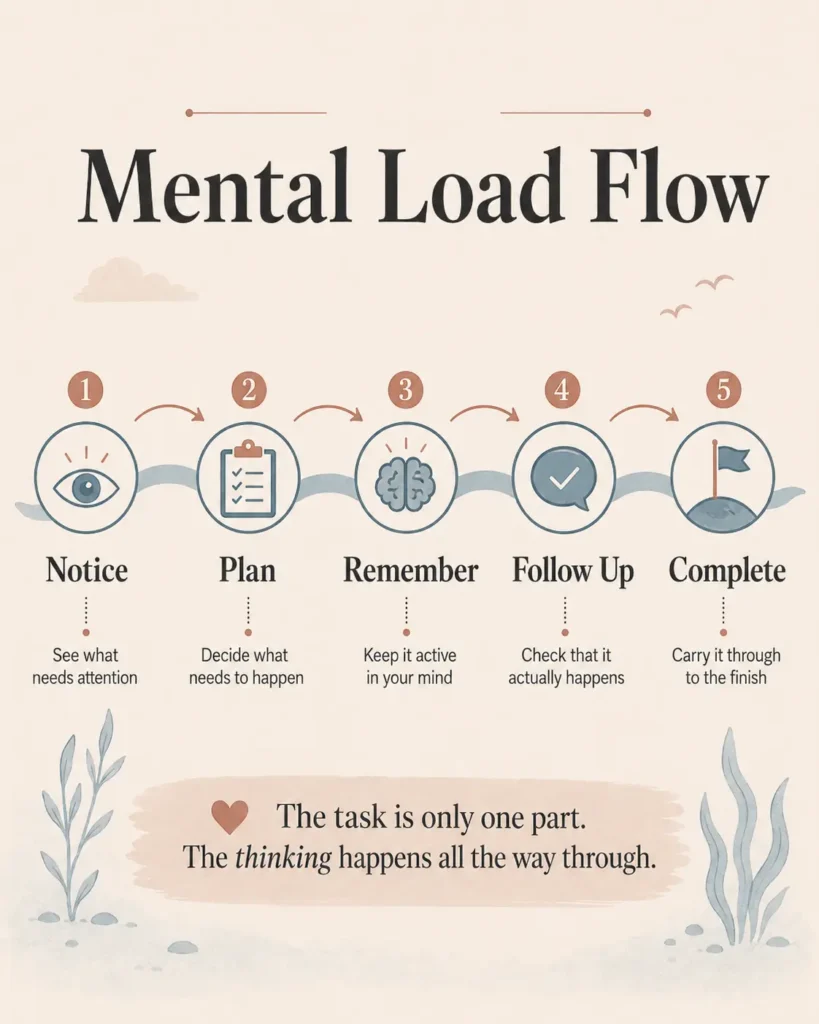
Do not only list the physical chores.
List what you track, notice, anticipate, remember, arrange, and check.
Your list might include:
- Groceries that are running low
- School messages and forms
- Medical appointments and prescriptions
- Bills and renewal dates
- Birthdays and family obligations
- Domestic help schedules
- Children’s uniforms, supplies, and activities
- Repairs that need following up
- Meals that need planning
- Relatives who need calling
- Items that must be packed before an outing
- Tasks that need completing before guests arrive
Your list will probably be much longer than you expect.
Mine was three pages, and I had not even reached the emotional responsibilities. Who was upset with whom. Whose birthday was coming. Which relative might feel ignored if we did not call.
The list is not a weapon.
Do not wave it in his face as evidence for the prosecution.
It is for you.
It helps you describe something real and specific instead of saying, “I’m overwhelmed,” and then struggling to explain why.
2. Pick the moment properly
Do not start at 11 p.m. after a terrible day.
Do not start while either of you is in the middle of the task you are annoyed about.
Do not begin on a Monday morning when everyone is already late.
Do not raise it in front of his parents.
Choose a quiet time when both of you have eaten and nothing urgent is waiting for the next hour.
A Sunday afternoon may not sound dramatic, but boring timing often leads to better conversations.
3. Decide what you want to change
Ask yourself honestly:
What would make this better?
“I want him to understand” is not enough.
Understanding is valuable, but it does not automatically change the arrangement.
He may understand, sympathize, and then ask where the dal is that same evening.
You do not only want sympathy.
You want a transfer.
You want specific responsibilities to leave your head and become someone else’s responsibility.
Choose two or three areas to begin with.
Do not try to hand over the entire three-page list in one conversation.
How to Explain the Mental Load to Your Husband
Now we come to the actual words.
I am giving you full sentences because I remember wanting someone to tell me exactly what to say.
Change them so they sound like you.
The wording does not need to be perfect. The structure matters more.
Start with your experience, not his failures
The fastest way to lose the conversation is to begin with everything he does not do.
The moment a sentence begins with “you never” or “you always,” most people stop listening and start preparing a defense.
Start inside your own experience instead.
You could say:
“I want to explain something about how I have been feeling. I am not bringing it up to attack you. I have been carrying something that I do not think I have ever explained properly.”
Or:
“Can I show you something I wrote down? It is not meant to make you feel bad. I want you to see it because I think I have been keeping a lot of work invisible without realizing it.”
That second sentence is my favorite because it is true.
We often help keep the work invisible.
Sometimes because we are proud of managing everything.
Sometimes because doing it ourselves feels easier than explaining it.
Sometimes because nobody taught us that we were allowed to ask for something different.
Use one recent example
Do not open the archives.
Six years of grievances is not a conversation. It is a trial.
Choose one small, recent, concrete example.
You could say:
“Yesterday, you made tea, and I appreciated it. But there was another part you may not have seen. I noticed on Tuesday that the tea powder was finishing, added it to the shopping list, checked that it was ordered, and made sure it arrived. I am not tired from making the tea. I am tired from constantly having to notice.”
Or:
“You picked him up from class, which helped. But before that, I messaged the coach, packed the bag, remembered the timing, and moved dinner earlier so we would be back in time. The pickup took fifteen minutes. The planning lived in my head all week.”
One example can make the invisible work understandable.
Twenty examples can feel like an attack.
Explain the difference between doing and remembering
This is the core idea.
You could say:
“There are two jobs in this house. Doing things and remembering that they need to be done. You do many of the visible tasks. I carry most of the remembering, and that is the part that never switches off.”
Or:
“When you ask me what you can do to help, I know you mean it kindly. But answering that question is part of the load. I still have to know everything that needs doing, decide what matters, and assign it. The thinking stays with me.”
That last point is worth saying slowly.
The question “What can I do?” often sounds generous.
But when one person must repeatedly identify, prioritize, explain, and delegate every task, that person remains the household manager.
Ask for Ownership Instead of Help
If you take one thing from this article, take this.
Stop asking only for help.
Help means you remain the manager and he becomes the assistant.
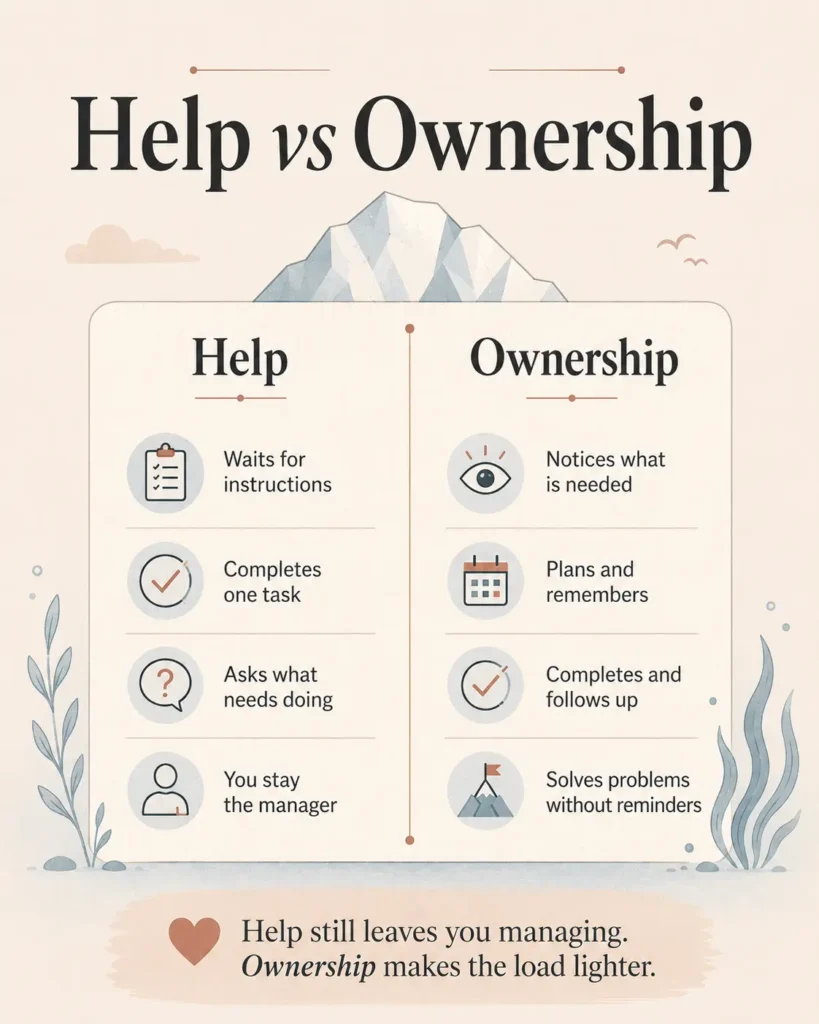
The file stays on your desk.
Instead, ask him to own something completely.
Ownership includes:
- Noticing
- Planning
- Remembering
- Doing
- Following up
- Solving problems when something goes wrong
You could say:
“I do not want help buying vegetables. I want vegetables to stop being something I have to think about. That means checking what we have, noticing when we are low, deciding what to buy, ordering or purchasing it, and handling it if something is missed.”
Or:
“Can school communication become entirely your responsibility? That would include reading the WhatsApp group, remembering form deadlines, tracking fee dates, and following up when something is unclear. I do not want to remain the person reminding you what is due.”
Choose responsibilities with clear boundaries.
For example:
- Groceries
- The car
- Utility bills
- One child’s school communication
- Medical prescriptions
- Domestic help payments and scheduling
- Family travel bookings
- Household repairs
Start with two or three.
Not all three pages.
Say What You Will Stop Doing
This is uncomfortable, but it is what makes the transfer real.
You could say:
“For this responsibility to leave my head, I need to step back from routinely checking and reminding you. Let us agree on a system that you will manage yourself.”
Then step back.
This does not mean you can never communicate or mention something important.
It means you stop being the permanent tracking system.
Help is something you ask for.
Ownership is something you hand over.
Only one of them consistently makes the mental load lighter.
What to Say When the Conversation Goes Sideways
The conversation may not go perfectly.
Here are some common responses and ways to bring the discussion back to the actual issue.
“So I do nothing? Is that what you’re saying?”
He has heard an insult where you meant a description.
Slow down.
You could say:
“No, that is not what I am saying. I know you do a lot. I am talking about a different kind of work that I do not think either of us has been counting.”
“Just tell me what to do and I’ll do it.”
He may mean this generously.
You could say:
“I know you are trying to help. But telling you what to do is the part I am trying to explain. To give you instructions, I must already be tracking everything. I need you to hold complete responsibility for some areas yourself.”
“My mother did all of this and she never complained.”
Do not turn the conversation into an argument about his mother.
You could say:
“She carried a great deal, and I respect that. Our circumstances are different, and this arrangement is not sustainable for me. I want us to build something that works for our marriage.”
Then return to the current issue.
You are not asking him to choose between you and his mother.
You are discussing how responsibility will be shared in the home where both of you currently live.
Silence, a shrug, or “We’ll talk later”
Let the conversation pause for that day.
Some people need time to process a difficult idea before responding properly.
You could say:
“Okay. I am not going to keep pushing right now. But this is important to me, so I would like us to return to it this week.”
Then return to it.
Calmly bringing it up again shows that this was not a passing mood.
The Handover Only Works If You Let It Be Done Differently
This is where many of us undo our own good work.
You hand over the vegetables.
He buys the wrong ones.
He forgets the coriander.
He chooses the expensive tomatoes.
You quietly begin checking again.
Then you start reminding.
Then you start “helping.”
Within three weeks, the whole responsibility is back in your head, and he believes he tried but could not do it correctly.
There is often an awkward period when the task is done differently or less efficiently than you would have done it.
You have to allow some of that.
Nothing catastrophic happens because there was no coriander.
Something very valuable happens when you go through an entire week without thinking about vegetables.
Lower the bar deliberately for the things that do not matter very much.
Some things in a home are glass.
Some are rubber.
We exhaust ourselves when we treat everything as glass.
This advice applies to low-stakes responsibilities.
It does not apply to medication, child safety, essential bills, medical appointments, or anything with serious consequences.
For high-stakes areas, agree on the required standard and system before transferring responsibility.
The aim is not to let important things fall apart.
The aim is to stop one person from being the only safety net.
A Simple Mental Load Ownership Plan
It may help to write down the first few areas you are transferring.
| Responsibility | Complete owner | Ownership includes |
|---|---|---|
| School communication | Husband | Reading messages, remembering dates, submitting forms, and following up |
| Groceries | Husband | Checking supplies, planning purchases, ordering, and replacing missing items |
| Utility bills | Wife | Tracking due dates, making payments, and handling account issues |
The purpose of this table is not to create another document for you to manage.
It is to remove ambiguity.
A responsibility should have one clear owner.
That owner can ask for support when needed, but the other person should not have to constantly monitor whether the task has been remembered.
How to Share the Mental Load in a Joint Family
Everything above still applies in a joint family.
But you already know the conversation has an extra layer.
You are not simply dividing one household between two adults.
You may be coordinating across generations, in a kitchen that had a system long before you arrived, with an unspoken expectation that the bahu will eventually manage everything.
Two principles have helped me here.
First, speak to your husband privately.
Do not raise the issue in front of his parents.
Do not announce a new household arrangement at the dinner table.
A private negotiation can quickly become a public accusation. People may close ranks, and the conversation will no longer be about the mental load.
Second, discuss the work itself, not his mother.
The moment his mother’s name enters the argument, the conversation becomes about loyalty. And if the household itself is the harder part of your marriage right now, I have written more honestly about that here: living with in-laws after marriage
You are not asking him to reject his family.
You are asking him to take responsibility for a fair share of the home you both live in.
Keep the conversation there.
In a joint household, it is especially helpful to transfer areas with clear edges.
For example:
- One child’s school communication
- The car and its maintenance
- Electricity, internet, and other bills
- Medicine refills
- Weekly groceries
- Repairs and service appointments
The clearer the boundary, the less room there is for the responsibility to quietly return to you.
When One Conversation Is Not Enough
I will not pretend I have this perfectly sorted.
I do not.
Some weeks, the entire list finds its way back into my head, and I notice only when I start snapping at everybody.
But things did move.
Slowly.
After more than one conversation that went badly before one finally went well.
You may need to explain the same idea more than once.
You may need to adjust which responsibilities are transferred.
You may discover that a shared calendar, reminder app, shopping list, or family planning session helps.
The system does not have to look the same in every marriage.
What matters is that the responsibility is genuinely shared, not simply completed when you assign it.
If your husband listens, tries, makes mistakes, and gradually takes ownership, the process may need time.
If he repeatedly mocks you, dismisses the issue, agrees but refuses to change anything, or uses anger to stop the conversation, the problem may no longer be a lack of understanding.
In that situation, individual or couples counseling may help, provided discussing the issue feels emotionally and physically safe.
You do not have to solve an unequal relationship by becoming better at explaining inequality.
You Are Not Asking for a Favor
If you are sitting there tonight running tomorrow’s list behind your eyes, here is what I want you to hear.
You are not asking him to help you with work that naturally belongs to you.
You are asking him to carry a fair share of the home you both live in.
That is not a favor.
It is not you being difficult, modern, ungrateful, or influenced by the internet.
It is an ordinary and reasonable expectation.
The strange part is how long so many of us went without saying it.
Do not try to hand over the entire three-page list this Sunday.
Write the list.
Choose one responsibility.
Hand it over completely, including the noticing and remembering.
Then step back long enough for the transfer to become real.
Start there.
A house should not run on one woman’s memory.
That woman deserves to forget something occasionally without the whole thing falling over.
If this letter found you at the right time, I hope you will stay.
Here at The Balanced Working Mom, I write about marriage, career, motherhood, home, and the invisible parts of a woman’s life that nobody really prepares us for.
If this letter found you at the right time, I’d love to write to you every week.
Join The Balanced Working Mom Letters for honest stories about marriage, motherhood, work, and the invisible parts of a woman’s life that nobody prepares us for.
You’ll also receive printable checklists and planners that help lighten the mental load—not just manage it.
Frequently Asked Questions
What is the mental load in simple words?
The mental load is the invisible work of remembering, planning, noticing, and organizing everything that keeps a household running. It includes tracking what is needed, anticipating problems, remembering dates, and checking that tasks have been completed. It is different from physical chores because it continues in your head even when you are not actively doing anything.
How do I explain the mental load to my husband without starting a fight?
Choose a calm time and begin with how you feel rather than listing everything he does wrong. Use one recent example to explain the difference between completing a task and remembering that it needs to happen. Then ask him to take complete ownership of two or three clearly defined responsibilities.
What is the difference between asking for help and sharing the mental load?
Asking for help often leaves one person in charge of noticing, planning, and delegating. Sharing the mental load means another person takes full ownership of an area, including remembering, planning, completing the task, and handling follow-up without repeated reminders.
Which household responsibilities should we hand over first?
Start with responsibilities that have clear boundaries and relatively low consequences if they are handled differently. Groceries, car maintenance, utility bills, repairs, or one child’s school communication may be easier to transfer than vague responsibilities such as “help more around the house.”
What if my husband says I have higher standards?
Discuss which standards are genuinely necessary and which are personal preferences. Agree on a basic result that both of you consider acceptable. For low-stakes tasks, allow the other person to complete them differently. For safety, health, financial, or child-related responsibilities, agree on clear requirements before handing them over.
What if my husband understands the mental load but nothing changes?
Move the conversation from general understanding to specific ownership. Agree on which responsibilities will transfer, what complete ownership includes, and when the change begins. If he repeatedly agrees but does not take responsibility, the issue may be willingness rather than understanding.
Can shared calendars and apps reduce the mental load?
They can help, but only when responsibility for maintaining them is also shared. A shared calendar does not reduce your load if you remain the only person entering every appointment, checking every deadline, and reminding everyone to look at it.
How do I share the mental load in a joint family?
Speak with your husband privately and keep the discussion focused on household responsibilities rather than his mother or other relatives. Transfer responsibilities with clear boundaries, such as bills, school communication, medicine refills, car maintenance, or repairs. Clear ownership is especially important when several generations share one household.
What should I do if discussing household responsibilities feels unsafe?
Prioritize your safety rather than forcing the conversation. Speak with someone you trust or seek support from a qualified counselor or local support service. You are not required to confront someone alone if you fear intimidation, retaliation, or violence.

Hey there,
I’m Anjali, founder of The Balanced Working Mom.
I write for modern Indian women navigating marriage, career, motherhood, home, and the quiet identity shifts that happen in between.
Everything I share comes from real life — from managing work and family to learning, slowly, how not to lose yourself while building a beautiful life.