
First Karva Chauth After Marriage: What’s Traditional, What’s Optional
Anjali Sharma
Working Mom, Founder & Editor of The Balanced Working Mom
Practical, research-led guidance for Indian women navigating marriage, motherhood & work.
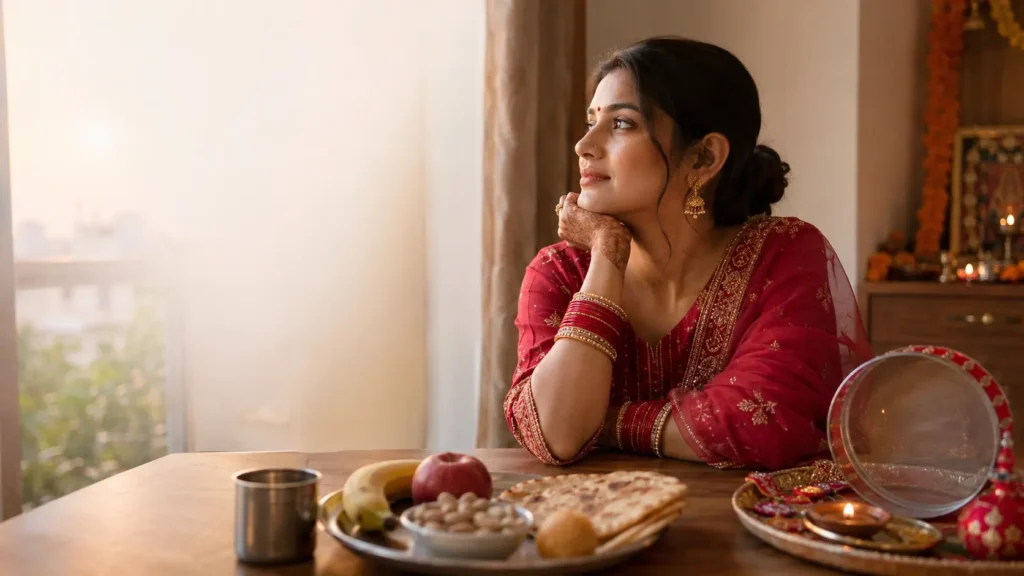
Table of Contents
The advice starts before you’ve even worked out what date it falls on.
Someone tells you sargi has to have exactly these things in it. Someone else says you should wear your wedding lehenga — the whole thing, in October. An aunt mentions, not entirely as a question, what your parents will be sending. A cousin explains that you cannot drink water, not even a sip, and looks concerned that you asked. Then you open Instagram and every reel is a woman in full bridal jewellery holding a sieve up to a moon that appears to be about nine feet away.
By the time your first Karva Chauth actually arrives, a festival with real meaning behind it can start feeling like an exam nobody gave you the syllabus for.
So here’s the honest version. Karva Chauth has long-standing traditions, and they matter to a lot of people. But how families observe them varies enormously — by region, by community, and often just by household.
Some of what you’re being told is genuinely traditional. Some of it is one specific family’s way of doing things. And some of it is entirely up to you and your partner.
This guide separates those three things.
Quick answer: Your first Karva Chauth may include a pre-dawn sargi, a day-long fast, dressing for the occasion, an evening puja and breaking the fast after moonrise. But customs differ between families and regions, and decisions like whether to fast, what to wear and how elaborate to make the day are personal ones.
First, What Actually Makes the First Karva Chauth after Marriage Different?
Structurally? Not much. The festival doesn’t change its rituals because you got married this year.
What changes is the attention.
Your first Karva Chauth is the one everybody turns up for.
In many families that means a more elaborate sargi than usual, gifts arriving from one side or both, new clothes, mehendi, photographs, and a larger gathering than the ordinary year.
Relatives who observe quietly at home will suddenly want to know your plans. In some communities the first observance carries genuine ceremonial weight, with specific customs attached to it.
In others, it’s just Thursday.
Both of those are real, and neither is a lapse.
Karva Chauth is most strongly associated with northern Indian traditions, and even within those, practices differ between neighbouring families.
If your mother-in-law’s version doesn’t match your mother’s version, nobody has made a mistake.
This is the same thing that happens with every first celebration after the wedding, which is why it helps to think of it as part of a bigger adjustment rather than a one-day problem. My guide to navigating your first festivals after marriage looks more broadly at family expectations, gifts, travel, traditions and creating celebrations that work for both of you.
First Karva Chauth Traditions at a Glance
| Tradition | What’s commonly done | Is it universal? |
|---|---|---|
| Sargi | Pre-dawn meal, particularly associated with Punjabi Karva Chauth customs | No |
| Fasting | Traditionally observed from morning until moonrise | Observance and strictness vary widely |
| Mehendi | A common festive custom | Optional |
| Bridal clothes or red attire | Popular for a first Karva Chauth | Optional |
| Evening puja | Central to many traditional observances | Details vary by family and region |
| Vrat katha | Often recited during the puja | Practice varies |
| Viewing the moon through a sieve | Widely recognised ritual | Customs differ |
| Gifts from in-laws | Common in some families | Not universal |
| Gifts from the woman’s parents | Practised in some communities | Not universal |
| A gift from the husband | Popular modern custom | Optional |
If you take one thing from this page, take the right-hand column.
Sargi: What It Is, and What Actually Matters About It
Sargi is the meal eaten before dawn, before the fasting period begins. It’s particularly associated with Punjabi Karva Chauth traditions, and in many families it’s given or prepared by the mother-in-law as a gesture of care.
What goes into it depends entirely on the household.
Fruit, dry fruits and nuts are common. Beyond that you’ll find parathas, mathri, sweets, milk-based dishes, and things that are on the list purely because someone’s grandmother always made them.
There is no single correct sargi. Anyone presenting you with a definitive list is usually describing their own family’s version.
Traditional: eating before sunrise if you’re observing the traditional fast.
Family custom: who prepares or sends it, and what’s in it.
Your choice: adapting the meal around work, dietary needs, medical requirements and what your body actually tolerates at 4:30am.
That last one matters more than people admit.
A sargi built entirely around foods you don’t usually eat, consumed in the dark, before a full working day, is not a good plan for anyone.
If you’re fasting and heading to work afterwards, my guide to what to eat in sargi to stay full all day covers practical meal combinations, hydration, caffeine and managing the fast through a working day.
Do You Have to Fast on Your First Karva Chauth?
Traditionally, Karva Chauth centres on a day-long fast observed by married women for their husband’s wellbeing, kept from morning until the moon is sighted.
That’s the practice, it’s been observed for generations, and for many women it’s genuinely meaningful — a day they look forward to rather than endure.
Whether you observe it is a religious, cultural and personal decision, and it belongs to you.
In practice, couples today do all of these things:
- Keep the traditional fast exactly as their family always has
- Keep it in a modified form
- Fast together, both partners
- Take part in the sargi, the puja and the evening without fasting
- Mark the day in some other way that means something to them
- Not observe it at all
None of these needs defending, and none of them is a statement about how much you love your husband.
A fast is not a loyalty test, and choosing not to keep one isn’t a critique of the women who do.
Both directions of judgement get tiring fast, and the first year is when you’ll feel them most.
One practical note on health
The traditional fast often means going without both food and water. Going for many hours without fluids can increase the risk of dehydration, and a nirjala fast isn’t suitable for everyone.
If you’re pregnant or nursing, have diabetes, take medication that needs food or regular timing, live with a condition affected by fasting, or simply feel unsure, talk to a doctor before the day rather than working it out at 4pm.
Plenty of people observe with medical adjustments.
That’s a legitimate way to keep the tradition, not a failure to keep it.
And if you become faint, confused, severely dizzy or otherwise unwell during the fast, your health takes priority.
What Actually Happens During the Day?
Before sunrise
Depending on your family: waking for sargi, eating before the fasting period starts, and in some households receiving blessings or small gifts.
In families where sargi comes from the mother-in-law, this is often the warmest part of the day — quiet, early, just the two of you in the kitchen.
During the day
Real life continues.
Many women work a normal day, take meetings, do the school run, and get mehendi done in the evening or the day before because there was no other window.
Others spend the day with relatives or with other women observing together, which in some families is half the point of the festival.
If most of what you’re seeing online shows a woman with an entirely free schedule, elaborate mehendi and a photographer, remember that you’re looking at content, not a standard.
The evening puja
Broadly: women gather where that’s the custom, the puja thali is prepared, the karva is placed, prayers are offered, and in many families the vrat katha is recited.
Beyond that, the specifics — the order, the items, who leads it, whether it happens at home or with a group — differ by family and region.
Ask someone in your family to walk you through their version rather than following a generic online script.
If you want to be sure of the details, a reliable panchang or someone in the family who leads the puja is a better source than a listicle.
Moonrise and breaking the fast
The fast traditionally ends after the moon is sighted.
The familiar sequence — viewing the moon, often through a sieve, offering water, looking towards your husband, then taking the first sip and bite from his hand — is widely recognised, and the details still vary between households.
Moonrise time varies by city.
Don’t rely on one number you saw on a national news site.
What Should You Wear?
Some newly married women rewear their wedding lehenga.
Some wear a red saree or suit.
Some wear bridal jewellery, keep the chooda on, get mehendi done, or do solah shringar the way their family does it.
All of that is celebratory custom.
It is not a national dress code.
Red is traditional and popular. It isn’t compulsory, and a festival is not improved by an outfit you can’t sit down in for four hours.
Wear traditional clothes, wear whatever your family associates with the day, or wear something comfortable that still feels like an occasion.
If your wedding lehenga is beautiful and impractical, there is a middle path and it is called “the dupatta.”
Do Your Parents or In-Laws Have to Send Gifts?
This is where first-year families most often overspend, and it’s almost always out of anxiety.
Some communities do have established gifting traditions around the first Karva Chauth: sargi from the mother-in-law, clothes or jewellery, sweets, gifts sent by the woman’s parents, baya, and gifts between the couple.
In those families the customs are specific, they’re known, and everyone already understands them.
In other families, none of this happens, and nobody thinks anything of it.
So before anyone starts buying: ask your partner what normally happens in their family.
Then ask the questions that actually decide it:
- Does the family exchange gifts?
- Who usually gives what?
- Is anything ceremonial expected?
- Is it symbolic or substantial?
- What feels comfortable for both families?
The reason this matters isn’t etiquette.
It’s that a newly married couple, or their parents, can end up spending seriously on a custom belonging to somebody else’s community, discovered on a shopping blog in October.
And if the pressure to get every new-family expectation right is starting to feel bigger than the festival itself, you may relate to my piece about feeling like you’re losing yourself after marriage.
What If Your Family Does It Differently?
They probably do, at least in part.
Differences show up in who gives sargi, what’s eaten, how the puja runs, what’s worn, whether gifts are exchanged, whether women gather, and how the fast is kept and broken.
A workable order of operations:
- Ask your partner what their family normally does.
- Ask your mother-in-law, or whoever leads it, which parts matter most to them — there are usually only two or three.
- Tell them what you grew up around. Most families like being asked and like being told.
- Decide together what the two of you are actually doing.
- Don’t let a version you saw on social media override the way your family has done it for thirty years.
Different does not mean wrong.
That applies in both directions, including to the traditions you brought with you.
What If You’re Working That Day?
Karva Chauth 2026 falls on Thursday, 29 October — a working day for most people, which makes planning less optional than usual.
- Check your schedule early and move anything that clashes with the evening
- Find out the expected puja timing before you commit to a late meeting
- Lay out clothes and puja items the night before
- Sort travel in advance if you’re celebrating at a family home
- Plan sargi properly if you’re fasting — 4am is not the hour for improvisation
- Tell your family early if work means you can’t follow their usual schedule exactly
That last point saves more friction than anything else on the list.
People adjust easily to information given in advance and badly to information given at 7pm.
If you already struggle with rushed office mornings, a simple working mom morning routine can help you move more of the preparation to the night before instead of trying to manage sargi, family routines and work all at once.
On timings: moonrise varies by city, sometimes by a fair margin. Check a reliable local source such as Drik Panchang’s Karva Chauth timings close to the festival and make sure the location is set to your city.
A Planning Timeline for Karva Chauth 2026
Two weeks before
Ask about family traditions.
Decide whether and how you want to observe.
Sort work.
Establish whether gifts are being exchanged.
Plan outfits.
One week before
Organise puja items.
Book mehendi if you want it.
Finalise travel.
Plan sargi.
The day before
Confirm local puja and moonrise timings.
Prepare everything you’ll need before dawn.
Lay out your outfit.
Confirm the evening plan with whoever you’re celebrating with.
On the day
Take part in the festival in front of you rather than trying to reproduce the one you’ve been scrolling past for three weeks.
Your First Karva Chauth Checklist
Before
- Ask what traditions your family actually follows
- Decide whether you’re fasting, and talk to a doctor if there’s any reason to
- Understand the sargi custom in your household
- Check your work schedule
- Agree gifts and a budget, as a couple
- Plan travel
- Confirm what’s needed for the puja
On the day
- Follow the traditions that mean something to you
- Ask when you’re unsure — nobody expects you to already know
- Leave yourself real time before the evening puja
- Check your local moonrise time
- Don’t measure your day against anyone else’s
What Your First Karva Chauth Actually Needs to Be
It doesn’t need to be the most elaborate one you ever celebrate.
There’s no rule that says the first has to set the standard for the next forty.
Traditions carry real meaning, and keeping them can be one of the better parts of joining a new family.
They should also fit your health, your work, your beliefs and the marriage you’re actually building.
Those things aren’t in conflict as often as the internet suggests.
So ask questions.
Find out what your families genuinely value, because it’s usually less than you fear and more specific than you expect.
Keep what’s meaningful to you.
And hold on to the difference between this is how our family does it and this is the only correct way to do it — because almost every argument about first festivals is really about someone confusing the two.
Frequently Asked Questions
What should I do on my first Karva Chauth?
Start by asking your partner what their family normally does — customs vary a lot.
If you’re observing traditionally, that usually means sargi before dawn, fasting through the day, preparing for the evening puja, and breaking the fast after moonrise.
Check your local moonrise timing, and decide in advance which parts you want to take on.
Is the first Karva Chauth special after marriage?
In many families, yes.
The first observance often comes with a more elaborate sargi, gifts, new clothes and a larger gathering.
But that varies considerably. Some families mark it significantly, while others treat it like any other year.
Neither approach is incorrect, and it’s worth finding out which one you’re walking into.
Who gives sargi on the first Karva Chauth?
Traditionally, the mother-in-law prepares or sends the sargi, a custom particularly associated with Punjabi Karva Chauth practice.
That said, arrangements differ between families — in some households the woman’s own mother sends it, in others the couple sorts it themselves, and in some it isn’t observed at all.
Is sargi compulsory for Karva Chauth?
No.
Sargi is an important tradition in some communities, especially Punjabi ones, rather than a universal requirement observed identically everywhere.
If it isn’t part of your family’s practice, its absence isn’t a gap.
If you are fasting, eating something substantial before dawn is a practical idea regardless of what it’s called.
Does a woman have to fast on her first Karva Chauth?
Fasting is the traditional heart of Karva Chauth, and for many women it’s genuinely meaningful.
Whether to observe it is a personal religious and cultural decision.
Health matters too — anyone who is pregnant or nursing, has diabetes, or takes medication affected by food timing should speak to a doctor first.
Can I celebrate Karva Chauth without fasting?
Yes.
You can take part in the sargi, the mehendi, the evening puja, the gathering and the moonrise ritual without observing the fast.
People mark the day in different ways depending on their health, beliefs and family traditions.
What matters is deciding deliberately what works for you.
Can a husband fast on Karva Chauth too?
The traditional vrat is associated with married women.
Some couples today choose to fast together, though it isn’t a historical requirement and isn’t universal.
It’s a personal decision between the two of you — and one worth mentioning to family in advance if you’re doing things differently from the usual household tradition.
What should I wear for my first Karva Chauth?
Wedding outfits, red sarees or suits, and bridal jewellery are all popular choices, and many women wear mehendi and chooda.
There’s no mandatory outfit.
Wear something traditional, something your family associates with the day, or simply something festive and comfortable — the day is long.
What is the date of Karva Chauth in 2026?
Karva Chauth falls on Thursday, 29 October 2026.
Puja and moonrise timings vary by city, so check a reliable local panchang closer to the date rather than relying on a single all-India time.

Hey there,
I’m Anjali, founder of The Balanced Working Mom.
I write for modern Indian women navigating marriage, career, motherhood, home, and the quiet identity shifts that happen in between.
Everything I share comes from real life — from managing work and family to learning, slowly, how not to lose yourself while building a beautiful life.