First Festivals After Marriage What Nobody Prepares You For
Anjali Sharma
Working Mom, Founder & Editor of The Balanced Working Mom
Practical, research-led guidance for Indian women navigating marriage, motherhood & work.
Table of Contents
Your first festival after marriage is supposed to be exciting. The new clothes, the family gatherings, the sweets, the photos, the feeling that you are starting a new chapter together.
Nobody really warns you about the complicated part.
Before marriage, festivals usually happen automatically. You know the traditions, the timings, the people who visit, the dishes that appear every year, and the small family habits nobody needs to explain.
After marriage, even a festival you have celebrated your entire life can suddenly feel different.
There are new traditions to understand, another family’s expectations to consider, travel plans to organise, gifts to buy, and one question that almost every newly married couple eventually faces:
Where are we spending the festival?
There is no universal answer. Every family has its own traditions, priorities and expectations. The goal is not to perfectly follow one family’s way of celebrating. It is to find a balance that works for both partners.
Your first festivals after marriage are about understanding each other, respecting both families and slowly creating traditions that belong to the two of you.
Why First Festivals After Marriage Can Feel So Different
On the surface, a festival is only a day or a few days of celebration.
Emotionally, it represents much more.
Your first festival as a married couple often becomes a moment where two families, two sets of traditions and two personal histories come together for the first time.
You Are Joining Traditions That Already Exist
Every family has festival routines that have developed over years.
Someone always prepares a particular dish. Someone handles decorations. Someone decides when the prayers happen. Someone knows which relatives need to be visited first.
The challenge is that families often do not explain these traditions because they do not see them as rules. They simply see them as “the way things are done.”
As a newly married person, you are entering a system that existed long before you arrived.
Taking the time to understand those traditions can make the experience much easier.
You May Feel Like You Are Being Observed
The first festival after marriage can sometimes feel like an unofficial introduction to your new role in the family.
Relatives may notice:
- How you participate in rituals
- Whether you help with preparations
- How you interact with family members
- What traditions you follow
- How comfortable you seem
Most of this attention comes from excitement and curiosity rather than criticism.
Still, it can feel overwhelming when you are trying to understand a new environment while also trying to make a good impression.
Remember that nobody expects you to know everything immediately. Many traditions are learned over time.
Your Partner Is Adjusting Too
It is easy to focus only on your own adjustment, but your partner may also be experiencing a major change.
They may be:
- Celebrating away from their childhood home for the first time
- Introducing you to family traditions
- Managing expectations from both sides
- Trying to make everyone feel included
The first festival after marriage is not only about fitting into someone else’s family. It is about supporting each other while both of you adapt.
Both Families May Expect Your Presence
One of the biggest challenges is that both families may naturally want you there.
One side may have a traditional celebration they consider important. The other side may have their own expectations.
Usually, the issue is not that families want too much. The issue is that everyone assumes their version is the obvious choice.
That is why communication between partners matters before the festival arrives.
Conversations to Have Before Your First Festival
Many first-festival problems are not caused by difficult situations. They happen because two people arrive at the same celebration with completely different expectations.
A conversation before the festival can prevent unnecessary stress.
Do not wait until the night before when travel is booked, relatives are asking questions and everyone is already emotional.
Decide Where You Will Celebrate
Start by discussing the practical options.
Depending on your situation, you may choose:
- Spending the festival with one family
- Splitting the celebration between both families
- Alternating festivals between families
- Alternating years
- Celebrating separately with each family on different days
- Hosting both families together
The best choice depends on distance, family customs and what feels fair to both partners.
Trying to visit everyone in a single day often creates more stress than happiness. A rushed celebration where everyone is exhausted usually does not create the memories you hoped for.
Understand Which Traditions Matter Most
Not every tradition carries the same importance.
Before the festival, ask your partner:
- Is there a specific ritual that the family considers important?
- What time does the main celebration happen?
- Are there traditional clothes expected?
- Are gifts exchanged?
- Which relatives usually visit?
- Are preparations started days before?
- Is there a particular dish or family custom that matters?
Understanding what genuinely matters helps you focus your energy.
You do not need to memorise every family tradition in one year. That would be impressive, but also slightly terrifying. Humans already struggle remembering passwords, and now we expect them to master entire family rituals overnight.
Discuss Your Festival Budget
The first festival after marriage often comes with additional expenses:
- Gifts
- New clothes
- Travel
- Decorations
- Sweets
- Hosting expenses
Decide your budget together before spending begins.
Many couples overspend during their first year because they want to make a good impression.
Thoughtfulness matters more than the amount spent.
A meaningful gift chosen with care will usually be remembered longer than an expensive gift bought out of pressure.
How To Celebrate Your First Festival With Your In-Laws
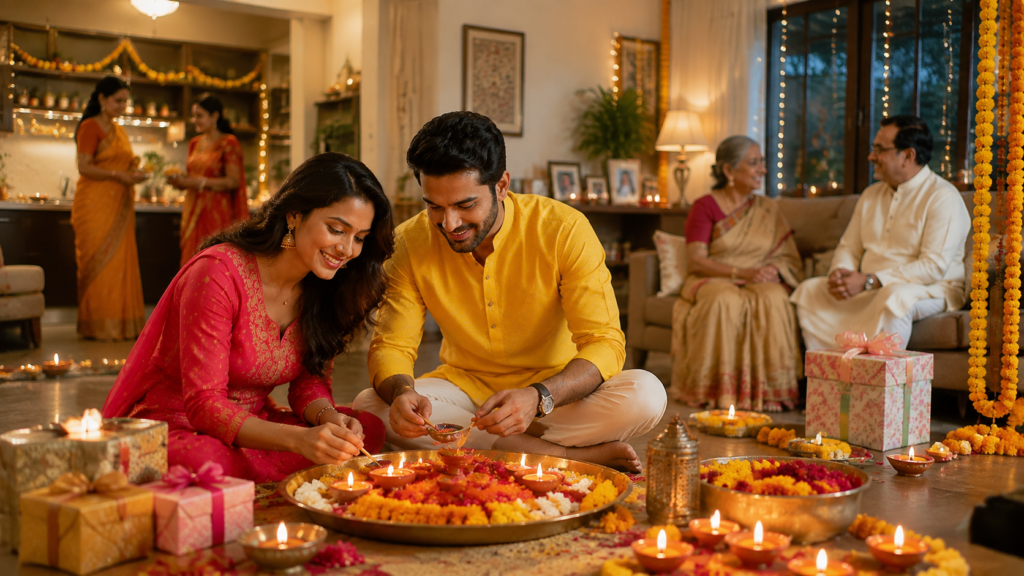
Meeting your in-laws during a festival can feel exciting and intimidating at the same time.
The most important thing to remember is that you are not expected to arrive knowing everything.
Nobody becomes an expert in another family’s traditions overnight.
Ask Your Partner to Explain the Day
Instead of asking:
“What should I do?”
Try asking:
“Can you walk me through how your family usually celebrates?”
Understanding the flow of the day helps you feel prepared.
Ask about:
- Morning routines
- Religious rituals
- Meal timings
- Family visits
- Expected responsibilities
- Anything that may surprise you
Offer Help Instead of Taking Over
Helping during a festival is usually appreciated.
However, there is a difference between offering support and changing someone’s established routine.
A simple:
“What can I help with?”
often works better than deciding what needs to be done.
Learn the Traditions That Matter Most
You do not need to become an expert in every custom immediately.
Focus on the traditions that are meaningful to your partner and their family.
Remembering one important ritual or family habit can mean more than trying to perform everything perfectly.
Do Not Try To Be Perfect
Many newly married people put pressure on themselves to make an excellent first impression.
But trying too hard can make the experience stressful.
Being warm, respectful and willing to learn matters more than getting every detail right.
Your family members are also meeting you as a new part of their lives. Building comfort takes time.
How Couples Balance Festivals Between Two Families
This is the question that comes back every year after marriage.
The first festival may feel complicated because there is often no perfect solution. One family may have a tradition that happens at a specific time, while the other family may also consider the celebration equally important.
Instead of trying to find a solution that makes everyone equally happy, focus on creating a plan that both partners believe is fair and realistic.
Alternate Festivals Between Families
One simple approach is to divide festivals between families.
For example:
- Diwali with one family
- Holi with the other family
- Regional festivals based on each family’s traditions
This works well when both families celebrate several festivals throughout the year and no single event carries all the emotional importance.
Alternate Years
For couples living in different cities, alternating years can often be easier.
One year may be spent with one family, and the next year with the other.
This allows you to be fully present rather than spending the entire festival travelling between locations.
A celebration where you are relaxed and connected usually creates better memories than trying to appear everywhere for a few hours.
Split the Celebration
If both families live nearby, splitting the day may work.
For example:
- Morning rituals with one family
- Evening celebrations with another family
However, this only works if travel is practical and both families understand the arrangement.
Trying to attend multiple celebrations that overlap can quickly turn a joyful day into a scheduling exercise. Humans have somehow managed to make festivals require project management skills.
Create Your Own Celebration
Over time, many couples create traditions that belong to them.
This could mean:
- Hosting both families
- Celebrating with friends
- Creating a separate celebration day
- Combining traditions from both families
Marriage does not mean choosing one family’s traditions forever. It means creating a shared life where both people feel represented.
First Festival Gifts For Your New Family
Gifting is one of the areas where newly married couples often feel the most pressure.
The first festival after marriage can create expectations around:
- Gifts for in-laws
- Gifts for relatives
- Family traditions
- Budget expectations
The best approach is to discuss gifting with your partner before you start shopping.
Your partner understands their family’s habits better than anyone else.
Ask What the Family Normally Does
Every family has different gifting traditions.
Some families exchange expensive gifts. Some prefer simple sweets or symbolic presents. Some families have stopped exchanging gifts completely.
Do not assume what is expected.
Ask:
- Who usually receives gifts?
- Is there a traditional gift?
- Are gifts exchanged individually or as a family?
- Is there a usual budget range?
Thoughtful Gifts Often Matter More Than Expensive Ones
A meaningful gift shows attention.
Examples:
- Something related to a family member’s interests
- A useful household item
- A traditional item from your own family
- A personalised gift
The goal is not to prove generosity. The goal is to build a connection.
Set a Shared Budget
Decide together:
- How much you want to spend
- Which gifts are important
- What you can comfortably afford
The first year can create habits that continue for years.
Spending beyond your comfort level because it is your first festival together may create unnecessary pressure later.
Avoid Comparing Yourself With Others
Every extended family has someone who gives extravagant gifts.
There will always be a relative who arrives with something bigger, more expensive or more impressive.
That does not mean you need to compete.
Your marriage is not a yearly gift competition. Thankfully, because humans have already invented enough competitions without adding “who bought the most impressive festival basket.”
When You Miss Celebrating With Your Own Family
This is one of the emotional parts of the first festival after marriage that people often do not discuss.
You can be happy in your new family and still miss your old traditions.
Both feelings can exist together.
You may miss:
- Your parents preparing for the festival
- Childhood routines
- Familiar food
- Family jokes
- The feeling of being at home
Missing those moments does not mean you are unhappy in your marriage.
It simply means those memories matter.
Talk About It Before the Festival
Many people wait until the festival day when emotions are already high.
Instead, tell your partner beforehand.
Explain:
- What traditions you miss
- Which moments are important to you
- When you would like to connect with your family
Your partner cannot support something they do not know you need.
Keep One Tradition From Your Childhood
You do not have to leave everything behind.
Small traditions can help you feel connected:
- Making a favourite family dish
- Wearing something meaningful
- Calling your family during an important moment
- Following a childhood ritual
Bringing something from your past into your new life can make the celebration feel more complete.
Schedule Time With Your Own Family
A festival does not have to happen only on one day.
You can:
- Visit your family before or after the festival
- Plan a separate meal
- Celebrate through a video call
- Host them another time
Creating space for both families helps avoid the feeling that one side has been left behind.
Your First Festival in a Joint Family
Living in a joint family can make your first festival feel overwhelming because the household already has established routines.
The good news is that those routines can also make things easier.
You do not have to figure everything out alone. The family already knows how things usually work.
Your job is to observe, learn and gradually participate.
Understand How Responsibilities Work
Before volunteering for everything, understand the existing routine.
Ask:
- Who handles decorations?
- Who prepares specific dishes?
- Who manages guests?
- Who handles shopping?
- What preparations start early?
Knowing the system helps you contribute in a way that feels natural.
Do Not Take On Everything Immediately
Many newly married people want to make a great impression and end up agreeing to too many responsibilities.
Helping is wonderful.
Trying to become responsible for every festival task in your first year is not sustainable.
Start small and build over time.
Use Your Partner as Your Guide
Your spouse is your connection to the family’s traditions.
They can explain:
- Why certain rituals happen
- What family members expect
- Which things are important
- How decisions are usually made
A supportive partner can make the adjustment much smoother.
Respect Traditions Without Losing Yourself
Joining another family’s traditions does not mean giving up your own.
A successful first festival after marriage is not about disappearing into someone else’s customs.
It is about creating a space where both people feel respected.
You Are Allowed To Start Traditions Of Your Own
One of the biggest misconceptions about the first festival after marriage is that one person has to completely adjust to the other person’s family traditions.
That is not how long-lasting traditions are created.
Every family tradition that feels permanent today was once something new. At some point, someone decided to cook a particular dish, decorate the house in a certain way or celebrate a festival differently.
Your marriage is the beginning of your own family traditions too.
The goal is not to perfectly recreate either person’s childhood celebrations. It is to take the meaningful parts from both sides and create something that feels like yours.
Combine Traditions From Both Families
Small combinations often become the traditions couples remember most.
You might:
- Cook a dish from each family
- Follow a ritual from both backgrounds
- Decorate your home using ideas from both sides
- Invite both families for a shared celebration
- Create a new tradition that belongs only to you
These small choices help both partners feel included.
Create Simple Traditions You Can Repeat
The best traditions are usually the ones that are easy to continue.
Some ideas:
- Take the same festival photograph every year
- Buy one new decoration each year
- Cook a special meal together
- Write each other a note during the festival
- Visit a meaningful place together
- Donate or volunteer as part of the celebration
A tradition does not become special because it is expensive or elaborate.
It becomes special because it happens again and again.
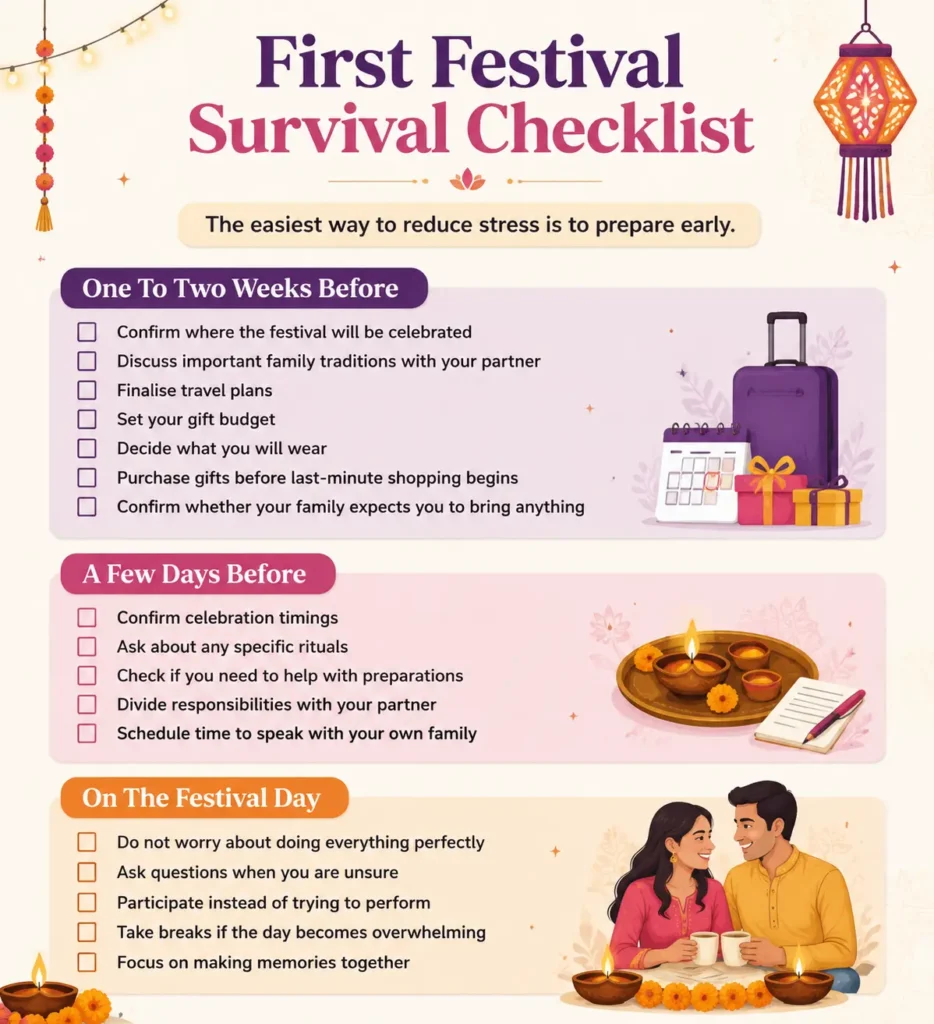
First Festival Survival Checklist
The easiest way to reduce stress is to prepare early.
One To Two Weeks Before
- Confirm where the festival will be celebrated
- Discuss important family traditions with your partner
- Finalise travel plans
- Set your gift budget
- Decide what you will wear
- Purchase gifts before last-minute shopping begins
- Confirm whether your family expects you to bring anything
A Few Days Before
- Confirm celebration timings
- Ask about any specific rituals
- Check if you need to help with preparations
- Divide responsibilities with your partner
- Schedule time to speak with your own family
On The Festival Day
- Do not worry about doing everything perfectly
- Ask questions when you are unsure
- Participate instead of trying to perform
- Take breaks if the day becomes overwhelming
- Focus on making memories together
The first festival does not need to be flawless.
Years later, you are unlikely to remember whether everything happened exactly according to plan. You are more likely to remember how you felt.
Your First Diwali After Marriage
Among all festivals, the first Diwali after marriage often carries special importance for many Indian families.
It may involve:
- Lakshmi Puja
- New clothes
- Family gatherings
- Gift exchanges
- Visiting relatives
- Decorating the home
- Preparing traditional sweets and food
However, Diwali traditions differ widely between families and regions.
Some families may have rituals centred around the newly married couple. Others may follow customs that have existed for generations.
There is no single “correct” way to celebrate your first Diwali after marriage.
The best approach is simple:
Ask your partner.
Planning Your First Diwali Together
A little preparation can make the celebration much easier.
Discuss:
- Which family you will visit
- Whether you will celebrate at home
- Who you will exchange gifts with
- Which traditions matter most
- How much you want to spend
- When you will connect with both families
Diwali often involves more planning than other festivals, so having these conversations early helps avoid unnecessary pressure.
First Diwali Gifts For Your New In-Laws
Choosing gifts for your in-laws can feel stressful, especially when you want to make a good first impression.
Focus on thoughtfulness rather than trying to impress with cost.
Some ideas include:
- Traditional sweets
- Home décor items
- Personalised gifts
- Useful household items
- Something connected to their interests
A gift becomes meaningful when it shows that you considered the person receiving it.
Internal link opportunity:
[First Diwali Gift Ideas For Your New In-Laws Without Overspending]
Different Festivals Bring Different Firsts
Every festival has its own traditions, but the questions remain similar:
Where will you celebrate?
What does each family expect?
Which traditions matter most?
How will you create your own memories?
First Lohri After Marriage
For many Punjabi families, the first Lohri after marriage is a significant celebration.
It may include:
- Family gatherings
- Gifts
- Traditional foods
- Celebrations around the bonfire
Customs vary between families, so discussing expectations beforehand can make the experience smoother.
First Holi After Marriage
Holi celebrations can be very different depending on family traditions.
Some families celebrate with large gatherings and colours, while others prefer smaller family moments.
Before your first Holi together, discuss:
- Where you will celebrate
- Who will be attending
- How involved you both want to be
First Teej After Marriage
In many communities, the first Teej after marriage carries cultural significance.
Traditions may involve gifts, visits between families and specific rituals.
Because customs vary significantly by region and community, couples should learn what matters to their own families rather than assuming one tradition applies everywhere.
Other Festivals After Marriage
The same questions apply to:
- Pongal
- Onam
- Durga Puja
- Ganesh Chaturthi
- Eid
- Christmas
- Regional New Year celebrations
The details may change, but the foundation remains the same:
Communication, flexibility and mutual respect.
The One Rule For Your First Festivals After Marriage
You do not have to create a perfect festival.
You do not have to make everyone completely happy.
You do not have to immediately understand every tradition.
The first year is about learning.
You are learning:
- What matters to your partner
- What matters to both families
- Which traditions you want to keep
- Which new traditions you want to create
At some point, every family tradition started with someone trying something for the first time.
Your first festival after marriage is not only about joining someone else’s celebrations.
It is the beginning of the traditions you will build together.
FAQs
What should I do for my first festival after marriage?
Start by discussing plans with your partner before the festival arrives. Talk about where you will celebrate, which traditions matter, what gifts are expected and how you will divide time between both families.
The most common source of stress is not the festival itself. It is assuming both partners have the same expectations without discussing them.
Where should a newly married couple spend their first festival?
There is no universal answer.
Some couples spend the festival with one family, some alternate between families, and others split celebrations between both sides.
The best choice depends on family traditions, location, travel requirements and what both partners agree feels fair.
How do couples balance festivals between two families?
Couples usually use one of four approaches:
- Alternate festivals
- Alternate years
- Split celebrations when practical
- Host both families themselves
The important thing is creating a system rather than making a stressful decision every time a festival arrives.
Is the first Diwali after marriage special?
For many Indian families, yes.
The first Diwali after marriage often includes larger gatherings, formal gifting and meaningful traditions.
However, customs differ between regions and households, so couples should discuss their own family expectations rather than assuming there is one standard celebration.
What should I gift my in-laws for the first festival after marriage?
Choose something thoughtful rather than focusing only on price.
Discuss expectations with your partner, understand what the family usually exchanges and decide on a comfortable budget together.
A meaningful gift that reflects attention is often more appreciated than an expensive one chosen only to make an impression.
What if my in-laws celebrate festivals differently from my family?
Different traditions are normal.
The goal is not to decide which family celebrates “correctly.” It is to understand each other’s customs and find ways to include both.
Bringing a small tradition from your own family can also help create a shared celebration.
Is it normal to miss my family during my first festival after marriage?
Yes.
Festivals are connected to childhood memories, familiar routines and family relationships.
Missing your old traditions does not mean you are unhappy in your new family. It simply means those moments are meaningful.
Talking openly with your partner and making time for your own family can make the transition easier.

Hey there,
I’m Anjali, founder of The Balanced Working Mom.
I write for modern Indian women navigating marriage, career, motherhood, home, and the quiet identity shifts that happen in between.
Everything I share comes from real life — from managing work and family to learning, slowly, how not to lose yourself while building a beautiful life.