
Mom Burnout Is Real: 10 Small Self-Care Habits for Working Moms Who Have No Time

I wanted to write about mom burnout because, honestly, some days it feels like my shift starts the moment I wake up.
I usually wake up around 4 or 4:30 in the morning. I work out, and before I even realize it, the day has already started. Breakfast, lunch, work from home, client deadlines, dinner prep, kitchen cleaning, Dhairya’s homework, next-day planning, and a hundred small things in between.
It does not feel like one task.
It feels like an endless list.
And the hardest part is that even when I am sitting, my mind is still running.
Where is this?
Where is that?
What needs to be packed?
What needs to be cooked?
Which deadline is pending?
What does everyone need next?
That is when burnout quietly enters.
So if you are a working mom feeling this way, this post is for you. Not the “wake up at 5 AM and do yoga” kind of advice. Just small, realistic self-care habits for working moms that actually fit into real life — the kind where dinner still has to happen, homework still has to be checked, and the house still needs you even after a full day of work.
For me, burnout does not always look like crying or breaking down. Sometimes it looks like not wanting to do anything at all. I do not feel like playing with my child. I do not feel like talking to anyone. I just want everything to stop for a while.
And I know many working moms feel this too.
Mom burnout is real. And no, it does not mean you are weak, lazy, ungrateful, or bad at managing life. Sometimes it simply means you have been carrying too much for too long without enough rest.
The hard part is that most working moms do not have the luxury of taking a full day off, going on a solo trip, or following a perfect self-care routine.
So this is not another “wake up at 5 AM and do yoga” kind of article.
Most of us are already waking up early.
What we need is not one more task.
We need small, realistic self-care habits that fit into real working mom life.
What Does Mom Burnout Feel Like?
Burnout does not always look dramatic from the outside.
You may still be attending meetings, replying to messages, packing school bags, helping with homework, cooking dinner, and smiling when needed.
But inside, you may feel completely empty.
For many working moms, burnout can feel like:
- Not wanting to do anything
- Losing patience quickly
- Feeling irritated by small things
- Not wanting to talk to anyone
- Feeling guilty even while resting
- Not enjoying time with your child
- Feeling tired even after sleeping
- Forgetting small things
- Feeling like everyone needs something from you
- Wanting silence more than anything else
For me, the biggest sign is when I do not feel like doing anything. I do not want to play. I do not want to talk. I do not want to plan. I do not want to be needed for a while.
That is when I know I am not just tired.
I am burned out.
The World Health Organization describes burnout as linked to chronic workplace stress, but for working moms, the feeling often does not stop when office work ends. The office shift ends, and the home shift begins.
Why Working Moms Burn Out So Easily
Working moms are not only managing work and parenting.
We are also managing the invisible mental load of the home.
Even when no one sees it, we are thinking about:
- What to cook
- What to pack in the tiffin
- Where the school socks are
- Whether the uniform is washed
- Whether the water bottle is clean
- What groceries are finished
- Which bill needs to be paid
- What homework needs checking
- What deadline is coming up
- What everyone needs next
Sometimes the most tiring part is not doing the task.
It is remembering everything.
It is being the person everyone asks, “Where is this?” or “Where is that?”
And when you work from home, the lines become even more blurred. You are physically at home, so people may think you are available. But you are still working. You still have deadlines, reports, calls, messages, and pressure.
For me, the first two weeks of the month are especially heavy because of client monthly performance reports. Deadlines are tight, work is intense, and I am sitting in front of a laptop for 8 to 9 hours.
Then evening comes.
And the second shift starts.
The Evening Chores Hit Differently
Evenings are the hardest part of the day for me.
After a full work shift, there is dinner to prepare, the kitchen to clean, Dhairya’s homework to check, the next day to plan, and small things everywhere that still need attention.
This is when the endless task list feels the heaviest.
Because by then, your brain is tired.
Your body is tired.
Your patience is low.
But the house still needs you.
The child still needs you.
Dinner still needs to happen.
The kitchen still has to be handled.
The next day still has to be prepared.
This is the part people often do not see. Working moms are not only tired because of work. We are tired because after work, we still have to meet everyone’s needs and expectations at home.
And sometimes that expectation feels heavier than the work itself.
Self-Care Does Not Have to Look Perfect
When people say “self-care,” it can sound like one more thing to schedule.
Go to the parlour.
Book a spa.
Wake up early.
Do meditation.
Start journaling.
Go for a solo coffee date.
Honestly, some of this advice can feel funny and unrealistic when your brain is full of deadlines, dinner, homework, school prep, and housework.
Going to the parlour sounds nice, but it is not always the answer to everyday burnout.
Real self-care for working moms has to be smaller.
It has to fit into the life we actually have.
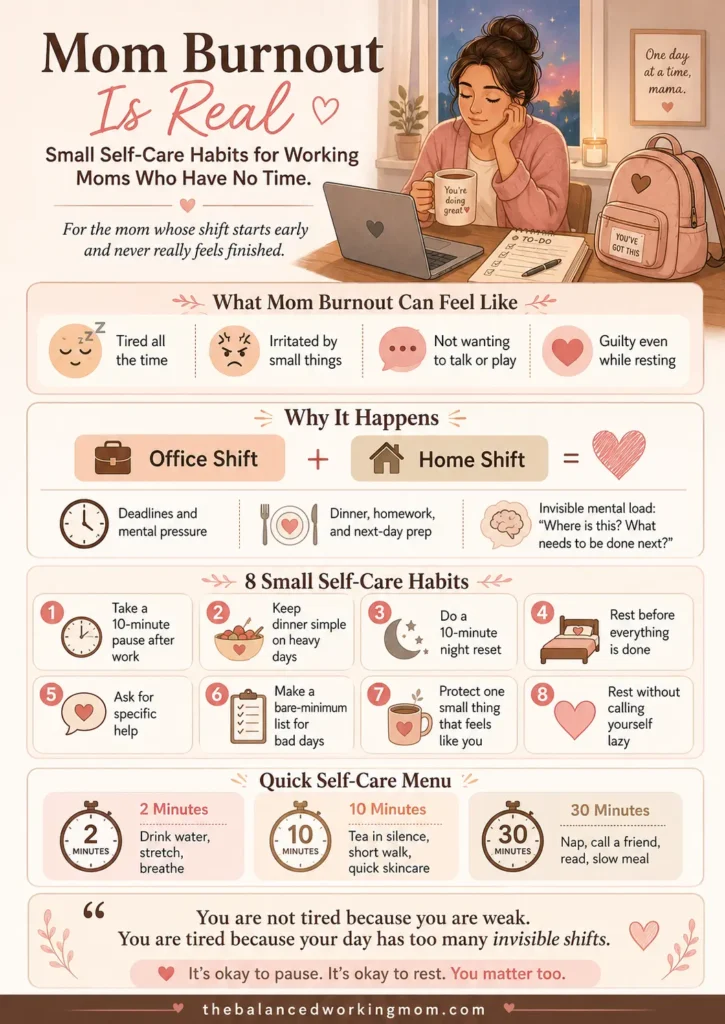
Self-care can look like:
- Sitting quietly for 10 minutes after shutting the laptop
- Choosing a simple dinner without guilt
- Not cleaning the whole kitchen perfectly every night
- Asking for help with homework or bedtime
- Drinking tea while it is still hot
- Sleeping instead of scrolling
- Saying no to one extra task
- Letting the house be imperfect
- Resting on a weekend without calling yourself lazy
UNICEF also talks about self-care for parents as something that can happen in small moments, including asking for help when needed. That feels much more realistic than trying to create a perfect self-care routine.
1. Start With a Small Pause After Work
If you work from home, it is very easy to close the laptop and immediately move to the kitchen.
There is no transition.
No travel time.
No mental break.
One moment you are in work mode, and the next moment you are expected to be in mom mode, cook mode, homework mode, and home manager mode.
Try creating a small pause between work and evening chores.
Even 10 minutes can help.
You can sit quietly, drink water, have tea, stretch your back, or simply do nothing for a few minutes before starting dinner.
This is not laziness.
This is a reset.
Small habit to try: After closing your laptop, take 10 minutes before starting the next household task.
2. Keep Dinner Simple on Heavy Workdays
Not every dinner has to be special.
On days when work is heavy, deadlines are stressful, or your energy is low, keep dinner simple.
Dal rice is dinner.
Khichdi is dinner.
Curd rice is dinner.
Roti and sabzi is dinner.
Leftovers are dinner.
Eggs and toast can also be dinner.
Simple food is still care.
As moms, we often put pressure on ourselves to make every meal fresh, balanced, and perfect. But when you are burned out, the goal is not perfection. The goal is to feed everyone without completely draining yourself.
If school mornings are also a stressful part of your routine, you can keep a few easy ideas ready from my post on 25 easy kids tiffin ideas for busy working moms. Planning a few repeat meals can reduce the daily “what should I make?” stress.
Small habit to try: Keep 3 emergency dinner options that you can make without thinking.
For example:
- Khichdi and curd
- Dal rice and papad
- Paneer or egg roll
- Vegetable pulao
- Simple roti sabzi
3. Do a 10-Minute Night Reset, Not a Full House Reset
At night, I often feel like there is so much to prepare for the next day.
School things.
Kitchen things.
Work things.
Clothes.
Bottles.
Lunch.
Homework.
Everything.
But trying to reset the full house at night can be too much.
Instead, do a 10-minute night reset.
Only handle the things that will make tomorrow morning easier.
You can:
- Keep the school bag ready
- Keep the uniform in one place
- Wash or fill the water bottle
- Decide the next day’s tiffin
- Keep your laptop and notebook ready
- Clear only the main kitchen counter
That is enough.
You do not need to clean every room before sleeping.
If school packing is one of your daily stress points, these guides may help:
The goal is not to create a perfect morning. The goal is to reduce morning panic.
Small habit to try: Set a 10-minute timer at night and only prepare the most important things for tomorrow.
4. Stop Waiting for Everything to Be Done Before You Rest
This is one of the hardest lessons.
Because for most moms, rest comes last.
We tell ourselves:
I will sit after the dishes.
I will rest after the laundry.
I will sleep after cleaning the kitchen.
I will relax after packing everything.
I will take time for myself after everyone else is sorted.
But the truth is, everything is never fully done.
There is always one more thing.
One more dish.
One more uniform.
One more message.
One more toy.
One more task.
If we wait for the house to be perfect before resting, we may never rest.
This is something I am still learning too. Even on weekends, if I decide once in a blue moon that I will not do anything, the guilt starts.
I wasted the weekend.
I could have done this.
I could have finished that.
I could have cleaned more.
I could have prepared better.
But rest is not wasted time.
Rest is how we come back to ourselves.
Small habit to try: Choose one time at night when you stop doing chores, even if something is still pending.
5. Ask for Specific Help
For working moms in joint families, this can feel especially complicated.
When family is always around, asking for help can feel strange. Everyone is already doing something. The sasuma is managing the kitchen. The in-laws are there. And somehow, asking for help still feels like admitting you cannot manage.
But being surrounded by people does not mean the load is automatically shared. The mental load — remembering what needs to be done, planning ahead, tracking everything — still sits with you. And in a joint family, there is often an extra layer: the expectation that you will manage everything quietly, without complaint, because that is what a good bahu does.
That expectation is heavy. And it is okay to gently push back on it.
Instead of a general “I need help,” ask for something specific and small.
Say:
- “Can you help Dhairya with homework today?”
- “Can you pack the school bag tonight?”
- “Can you clean the lunch box?”
- “Can you order vegetables?”
- “Can you handle bedtime today?”
- “Can you clear the dining table?”
- “Can you keep the water bottle ready?”
Specific help is easier for others to understand.
And asking for help does not mean you are not managing well.
It means the home is not your responsibility alone.
The American Psychological Association has written about parental burnout and how support matters. That is important because burnout does not always improve by simply telling moms to “take care of themselves.” Sometimes the load itself needs to be shared.
Small habit to try: Hand over one repeat task permanently, not just once.
6. Create a “Bare Minimum” List for Bad Days
Some days are not normal days.
Some days you are exhausted.
Some days work is too much.
Some days your child needs extra attention.
Some days the house is messy, your mind is full, and even small tasks feel heavy.
For those days, create a bare minimum list.
This means deciding what truly needs to happen and what can wait.
Your bare minimum list may look like:
- Finish urgent work
- Feed everyone something simple
- Help with only necessary homework
- Keep school essentials ready
- Take a bath
- Sleep
That is enough.
You do not need to be productive every day.
You do not need to cook a full meal, clean the whole house, reply to every message, and be cheerful at the same time.
Small habit to try: Save a “bad day list” in your phone with only 4 to 5 must-do tasks.
7. Make Home Tasks Easier, Not Perfect
Sometimes self-care is not about adding something new.
It is about making daily tasks easier.
If cleaning drains you, simplify it.
If cooking drains you, repeat meals.
If tiffin drains you, rotate the same 5 to 7 options.
If school prep drains you, keep a fixed basket for school items.
If floors get dirty again and again, use simple cleaning methods instead of trying to deep clean every day. I have shared some simple ideas in my post on how to clean floors naturally, but honestly, even there, the goal is not a perfect home. It is a manageable home.
A lived-in house is not a failed house.
A simple meal is not a failed meal.
A tired mom is not a failed mom.
Small habit to try: Pick one daily task and ask, “How can I make this easier?”
8. Protect One Small Thing That Feels Like You
Motherhood can slowly take over your full identity.
You become the person who remembers everything, plans everything, cooks, works, helps, cleans, reminds, checks, and manages.
But somewhere in between, you also need something that feels like you.
Not mom-you.
Not employee-you.
Just you.
It can be very small.
Maybe it is listening to music while cooking.
Maybe it is drinking tea in silence.
Maybe it is doing skincare at night.
Maybe it is reading two pages before sleeping.
Maybe it is sitting alone for 10 minutes.
Maybe it is wearing something that makes you feel good.
Maybe it is going for a short walk.
Maybe it is doing nothing without guilt.
You do not need a big routine.
You need one small thing that reminds you that you still exist outside everyone’s needs.
Small habit to try: Choose one “just for me” habit and do it three times this week.
9. Rest Without Calling Yourself Lazy
This is difficult for many moms.
We can be exhausted and still feel guilty for resting.
We can be sick and still think about pending chores.
We can sit for 10 minutes and feel like we are wasting time.
But rest is not laziness.
Rest is basic maintenance.
Your phone needs charging. Your body and mind do too.
Try changing the way you talk to yourself.
Instead of saying, “I wasted my weekend,” say, “I needed recovery.”
Instead of saying, “I should have done more,” say, “I did enough for today.”
Instead of saying, “I am lazy,” say, “I am tired.”
Because sometimes that is the truth.
You are not lazy.
You are tired from carrying too much.
Small habit to try: Take one guilt-free rest break this week and do not try to “make up for it” later.
10. Talk Before You Break Down
Many moms keep going until they finally cry, shout, fall sick, or shut down completely.
But we do not have to wait until that point.
Talk to someone before you break down.
A friend.
Your partner.
Your sister.
Your mom.
Another working mom.
A therapist.
Someone who will listen without judging.
Even saying “I am not okay” can feel like relief.
And if your burnout feels constant, if you feel hopeless, very anxious, emotionally numb, or unable to manage daily life for a long time, please consider speaking to a mental health professional.
Needing support does not mean you are failing.
It means you are human.
A Simple Self-Care Menu for Working Moms Who Have No Time
When you do not know what to do, pick one small thing from this list.
If you have 2 minutes
- Drink a glass of water
- Close your eyes
- Take 5 deep breaths
- Stretch your neck and shoulders
- Step outside for fresh air
- Put your phone away
If you have 10 minutes
- Drink tea without multitasking
- Sit quietly after work
- Listen to one song
- Take a short walk
- Do a quick skincare routine
- Lie down without scrolling
If you have 30 minutes
- Take a nap
- Call a friend
- Watch something light
- Read a few pages
- Go for a walk alone
- Eat slowly without rushing
Self-care ideas for mothers do not have to be impressive.
They only have to give a little energy back to you.
Real Mom Reminder
You are not tired because you are weak.
You are tired because your day has too many invisible shifts.
Office shift.
Mom shift.
Kitchen shift.
Homework shift.
Planning shift.
Emotional support shift.
That is a lot for one person.
So if today all you can do is pause, breathe, and make a simple dinner, that still counts.
Final Thoughts
Mom burnout is real.
And for working moms, it can feel even heavier because there is always another role waiting.
Employee.
Mother.
Partner.
Cook.
Planner.
Daughter.
Problem-solver.
The person who knows where everything is.
But you are not a machine.
You are allowed to feel tired.
You are allowed to need help.
You are allowed to rest before everything is finished.
You are allowed to pause.
If you are a working mom feeling burned out, I want you to remember this:
You do not always need to manage better.
Maybe you are already managing too much.
It is okay to rest.
It is okay if the house is not perfect.
It is okay if dinner is simple.
It is okay if you are not cheerful all the time.
It is okay to ask for help.
It is okay to choose yourself in small ways.
You are not failing because you are tired.
You are tired because you have been carrying a lot.
And sometimes, the most productive thing you can do is stop for a moment and let yourself breathe.
FAQs About Mom Burnout and Self-Care
What is mom burnout?
Mom burnout is a state of deep physical, mental, and emotional exhaustion that can happen when a mother has been carrying too much stress for too long without enough rest or support. It can make normal daily tasks feel overwhelming.
What are common signs of burnout in working moms?
Common signs include constant tiredness, irritability, guilt, lack of motivation, emotional numbness, trouble focusing, and feeling like you are always behind. Some moms may also feel disconnected from things they usually enjoy.
How can working moms practice self-care with no time?
Start with small habits. Sit quietly for 10 minutes, drink water, simplify one meal, sleep earlier, ask for help with one task, or take a short phone-free break. Self-care does not have to take hours to matter.
What are some quick self-care ideas for mothers?
Even two minutes counts. Drink a glass of water. Step outside for fresh air. Put your phone away. Take five deep breaths. These small moments add up and are some of the most realistic self-care ideas for mothers with no spare time.
Is it selfish for moms to take time for themselves?
No. Taking time for yourself is not selfish. It helps you recover, think clearly, and show up with more patience and energy. Mothers need care too.
What should I do if I feel burned out all the time?
Start by telling someone you trust and asking for practical help. Reduce non-urgent tasks where possible. If the feeling continues, or you feel hopeless, anxious, emotionally numb, or unable to manage daily life, speak with a mental health professional.

Hey there,
I’m Anjali, founder of The Balanced Working Mom.
I write for modern Indian women navigating marriage, career, motherhood, home, and the quiet identity shifts that happen in between.
Everything I share comes from real life — from managing work and family to learning, slowly, how not to lose yourself while building a beautiful life.